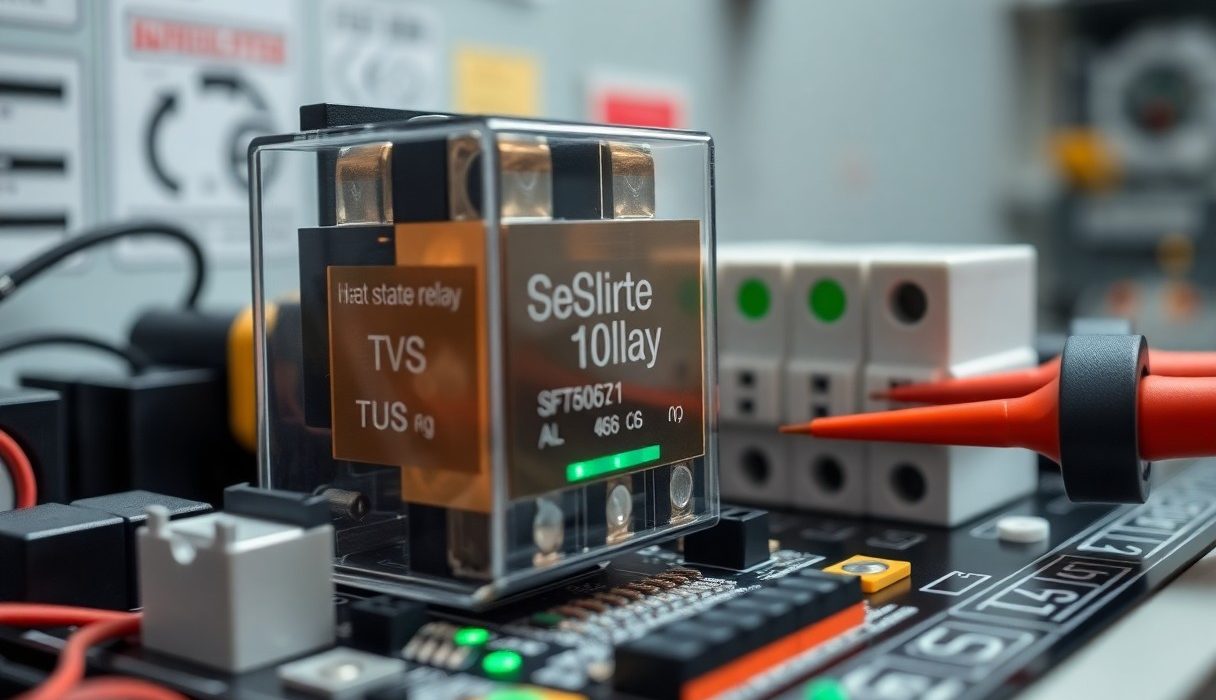
Relays built from solid-state switches give you fast, contactless switching that reduces electrical arcing, contact wear, and the fire and shock risk of mechanical failure. They also allow precise fault detection, integrated overcurrent protection, and galvanic isolation to make your systems more reliable, predictable, and lower maintenance.
Types of Semiconductor Relays
- Opto-Isolated Relays
- Solid State Relays (SSRs)
- AC SSR (Zero-cross)
- DC SSR (MOSFET)
- Photovoltaic/Hybrid Relays
| Type | Key characteristics & safety impact |
|---|---|
| Opto-Isolated Relays | LED-driven isolation providing up to ~3 kVrms galvanic separation; response typically 0.2-3 ms; common in PLC inputs and medical/industrial isolation layers. |
| AC SSR (Zero-cross) | Thyristor/TRIAC output that switches at line zero to reduce inrush; suitable for AC heaters and motors; typical leakage mA range and hysteresis can affect sensing circuits. |
| DC SSR (MOSFET) | MOSFET-based outputs with low RDS(on) (tens of mΩ), fast switching (tens of μs-ms), and lower off-state leakage (μA-100 μA) for battery and DC power control. |
| Photovoltaic / Hybrid Relays | Very low leakage (μA), high-speed isolation using photovoltaic stacks or hybrid electro-mechanical designs; used where signal integrity and safety isolation are paramount. |
Opto-Isolated Relays
When you need galvanic separation between control electronics and a high-voltage or noisy power stage, opto-isolated relays are a common choice: an LED drives a photodiode or phototransistor to transfer the signal without a conductive path, yielding isolation ratings often in the kilovolt range and predictable creepage/clearance behaviour for compliance testing. In practice you’ll see isolation specified as 2.5-4 kVrms in industrial modules, and the devices are used in PLC interfaces, sensor isolation, and medical front-ends where meeting IEC isolation tests is required.
Operation is straightforward but not without trade-offs: the optical path ages as the LED degrades, so output amplitude and switching thresholds can drift over thousands to tens of thousands of hours, which can create latent failure modes in safety circuits unless you add redundancy or periodic validation. Also expect switching times in the hundreds of microseconds to low milliseconds, meaning opto-isolators are excellent for logic separation and interlock signaling but less suited to very high-speed power switching.
Solid State Relays (SSRs)
You’ll encounter two broad SSR architectures: AC SSRs that use TRIACs/thyristors and DC SSRs built from MOSFETs or IGBTs. SSRs eliminate contact bounce and offer lifetimes measured in 10^7-10^9 cycles, with commercial modules rated from a few amps to >100 A; for example, a common industrial AC SSR is rated at 25 A/240 VAC with an off-state leakage of a few mA, while MOSFET DC SSRs can handle 30-60 A with on-resistances in the 10-100 mΩ range.
Safety considerations are operational and thermal: SSRs produce conduction losses that translate to heat – a 25 A SSR with 50 mΩ RDS(on) dissipates ~31 W at full load without heatsinking, so you must follow manufacturer derating curves and add heatsinks or forced air to avoid thermal runaway. Additionally, AC SSRs leave residual leakage that can keep indicator lamps or control inputs energized; for safety-critical load isolation you often pair SSRs with mechanical contacts or provide dual-redundant SSRs and diagnostic feedback to detect a stuck-on failure.
For robust application design you should apply snubbers or RC networks on inductive loads, verify zero-cross versus random-turn-on behaviour for your load type (zero-cross reduces inrush for resistive loads, random-turn-on allows phase control), and check the SSR’s specified off-state leakage and short-circuit withstand. Recognizing how SSR thermal derating, leakage characteristics, and switching style interact with your safety functions lets you arrange redundancy, monitoring, and physical isolation strategies that meet both functional and regulatory safety goals.
Key Factors in Choosing Semiconductor Relays
When you evaluate semiconductor relays, prioritize items that directly affect safety and long-term reliability: load type, steady-state and surge currents, thermal management, isolation voltage, and switching behavior (zero-cross vs. random turn-on). Practical trade-offs include higher switching speed and longer life at the expense of leakage current and heat dissipation; for example, a MOSFET-based SSR that handles 25 A continuous will typically require a heat sink and derating above 25°C ambient, whereas a TRIAC SSR may be simpler for AC resistive loads but cannot switch DC.
- Load type (AC resistive, AC inductive, DC, capacitive)
- Continuous current rating and inrush current capability
- On-state losses (Rds(on) or voltage drop) and resulting thermal dissipation
- Isolation voltage and creepage/clearance for your system voltage
- Switching mode (zero-cross vs random) and EMI implications
- Package thermal resistance, mounting method, and required heatsinking
Knowing which of these parameters dominates your application will guide whether you select a fast MOSFET SSR for low-voltage DC switching, a high-current AC SSR with snubber networks for inductive loads, or a hybrid device designed for motor control.
Load Requirements
You must size the SSR not just for steady-state current but for the worst-case dynamic conditions: inrush currents for motors or lamp loads can be 5-10x the running current, and capacitive loads can place large dV/dt stress on the semiconductor. For example, a 10 A running motor that draws 60 A at startup will require an SSR rated for that surge (or an external inrush limiter); otherwise you risk device failure or nuisance shutdowns.
Pay attention to on-state losses (Rds(on) for MOSFET SSRs or voltage drop for TRIACs) and calculate power dissipation: P = I^2 × Rds(on). If your SSR dissipates 10 W at operating current, you need a heatsink sized to keep case temperature below the component’s specified limit-many SSRs derate linearly with case or ambient temperature, so plan for thermal margins and use temperature monitoring or derating tables from the datasheet to avoid thermal runaway.
Environmental Conditions
Ambient temperature, humidity, vibration, and altitude all affect SSR selection: many modules are specified at 25°C ambient with derating curves above that point, and you should expect continuous-current ratings to drop significantly at elevated temperatures-an SSR rated at 25 A at 25°C may be limited to ~12-15 A at 70-85°C depending on thermal resistance and mounting. In high-humidity or corrosive atmospheres, choose parts with conformal coating or higher ingress protection; otherwise you risk insulation breakdown and arcing under high voltage.
Mechanical mounting and enclosure cooling determine how effectively you can remove heat: forced-air cooling or a properly sized heatsink can double the usable current compared with natural convection. Also consider altitude-reduced air density lowers convective cooling and reduces creepage distances needed for high-voltage isolation, increasing the chance of dielectric failure if you don’t adjust your design.
Knowing EMI/EMC constraints and how SSR switching waveforms interact with your system will help you specify snubbers, RC networks, or filters to limit conducted and radiated emissions to meet standards such as CISPR 11 while preventing spurious trips or interference with sensitive electronics.
Step-by-Step Guide to Implementing Semiconductor Relays
Quick Implementation Overview
| Step | Key actions & numbers |
| Assessment of System Needs | Measure steady-state and peak (inrush) currents, switching frequency, ambient temperature; size SSR ≥30-50% above peak current; verify required isolation voltage (1.5-3 kV typical). |
| Selection | Choose MOSFET-based SSR for DC or low-loss AC, zero-cross for resistive AC, random turn-on for inductive loads; select ON-resistance and voltage rating with margin (e.g., 40-100 V DC, 10-100 A). |
| Thermal & Mechanical Design | Calculate Pd and use RθJA/RθJC to size heatsink; aim for junction <100-110°C under worst-case ambient; use insulating pads if needed. |
| Control Interface & EMI | Match drive voltage/current (e.g., 3-32 VDC input); separate power and control wiring; add RC snubbers or MOVs for inductive spikes. |
| Safety & Diagnostics | Implement fail-safe wiring, series contactors for life-safety circuits, and current/temperature feedback; consider SSRs with integrated fault reporting. |
| Test & Commissioning | Perform thermal soak tests at maximum duty cycle and highest ambient, verify isolation with hipot test (per applicable standard), and log switching cycles and temperatures for 24-72 hours. |
Assessment of System Needs
You should start by quantifying electrical and environmental parameters: measure steady-state current, peak inrush (which can be 3-10× steady current for motors/capacitive loads), switching frequency (Hz or cycles per hour), and ambient temperature range (for example, -20°C to +55°C in many industrial sites). Use those values to select an SSR with at least a 30-50% current margin and a voltage rating comfortably above the system’s highest transient; undersizing here risks thermal runaway or catastrophic failure.
Next, evaluate the safety architecture and diagnostic expectations. If your safety loop requires galvanic isolation >2 kV or you need SIL/PLe-level assurance, include opto-isolated drivers and redundant switching or series mechanical contacts. For high-cycle applications (tens of thousands of operations per day), expect semiconductor relays to outperform mechanical relays in MTBF by multiple times, but plan for thermal dissipation and add temperature monitoring or current sensing to detect degradation early.
Installation Process
Mount SSRs to a heatsink or panel per the manufacturer’s thermal specs and use thermal interface material where indicated; for screw terminals, torque to the recommended range (typically around 0.4-0.6 Nm for small connectors) and use conductors sized for the expected current (for example, AWG 12 for continuous 20 A service). De-energize circuits and verify isolation before wiring; twisted pair or shielded control wiring reduces EMI, and you should separate power and signal runs to avoid induced noise on control lines.
Implement suppression and layout practices to protect against transients: place RC snubbers or MOVs across inductive loads (select MOVs rated 10-20% above peak system voltage), and add an RC network (for example, 100 Ω + 0.1 µF) where needed to tame dv/dt. Also include diagnostics-either SSRs with built-in status outputs or an external current/temperature sensor-so your control system can detect open/short conditions and respond with a safe shutdown; failure to include diagnostics can mask a failing SSR until it becomes a hazard.
For PCB-mounted SSRs, calculate junction temperature using Tj = Ta + Pd × RθJA; for example, with Ta = 40°C, Pd = 2 W and RθJA = 15°C/W, Tj = 40 + 2×15 = 70°C, which gives margin below typical Tj,max of 125°C. When sizing heatsinks for panel-mounted modules, ensure the combined thermal resistance (RθJA or RθJC plus heatsink Rθ) keeps junction temperature below your derated limit at the highest ambient; as a rule of thumb, target an overall Rθ ≤ (Tj_max − Ta_max)/Pd to maintain safe operation under worst-case load.
Tips for Optimizing Relay Performance
You should size semiconductor relays with explicit derating for ambient temperature and switching frequency: if a relay is rated at 10 A at 25°C, derate it to ~7 A at 40°C and factor in extra margin when you switch above a few hundred hertz because switching loss increases heating. Also verify off‑state leakage and on‑state voltage drop against the datasheet – a rise in on‑state Vdrop by more than 20% or leakage exceeding the specified value often signals accelerated wear. When you design the PCB and enclosure, include thermal vias, a dedicated copper plane under the relay, and clear airflow paths to keep junction temperature well below the device Tj(max).
- Use thermal management calculations (Tj = Ta + Pd × RθJA) during selection; for example, 2 W dissipated into a 10 °C/W package raises junction by 20 °C.
- Choose relays with integrated temperature sensing or add external NTC/PTC monitoring for automatic shutdown at high temps.
- Apply snubbers and surge protection to limit transient energy; protect long cable runs with MOVs or TVS rated for expected surge energy.
- Track cumulative switching cycles and load profile; if the datasheet lists >10⁷ cycles, schedule service before you reach ~10⁶ cycles in safety‑critical systems.
Recognizing that proactive thermal design and lifecycle monitoring reduce the likelihood of overheating, thermal runaway, and unexpected failures will let you maintain higher system safety margins.
Proper Heat Management
You should calculate steady‑state power dissipation and choose heatsinking accordingly: use the package RθJA from the datasheet and compute the temperature rise – for example, 3 W dissipation into 8 °C/W yields a 24 °C rise above ambient, so pair that relay with a heatsink or copper plane sized to bring RθJA below ~4 °C/W if your ambient sits near 40 °C. When you mount a heatsink, apply a thin layer of thermal interface material and torque fasteners to the manufacturer’s spec to avoid increasing thermal resistance.
For higher‑power or high‑frequency switching, add forced convection: small fans in the 20-40 CFM range often cut case temperature by 8-15 °C depending on enclosure, and ducting to create laminar flow over the relay body is more effective than general cabinet circulation. If space is limited, select relays with lower on‑state resistance or multi‑device paralleling with matched current sharing and ensure each device has its own thermal path to prevent one unit from overheating the rest.
Regular Maintenance Practices
You should inspect relays on a scheduled basis and use objective measurements: log on‑state Vdrop, off‑state leakage, and case temperature under typical load; increases of >15-20% in Vdrop or case temps rising above the expected range indicate aging. Visual checks for discoloration, cracked encapsulation, or burned terminals every 3-6 months in industrial environments help you catch mechanical or environmental damage early.
Include diagnostic checks such as periodic insulation resistance testing (for example, >100 MΩ at rated test voltage for safety circuits) and functional cycle tests under load; in safety systems perform these at least quarterly, and document each result against the relay’s specified MTBF and cycle rating. When you find deviation from baseline, swap the unit to a spare and perform a full bench evaluation including thermal imaging and leakage measurement.
Maintain a parts‑life log tying accumulated switching cycles and duty cycle to replacement intervals – if the relay spec shows 10⁷ switching cycles, plan conservative replacement at 10-20% of that rating in mission‑critical equipment, and use IR scans during operation to discover hotspots that predictive logs might miss.
Pros and Cons of Semiconductor Relays
| Pros | Cons |
|---|---|
| No mechanical contacts – no arcing, minimal wear | Off-state leakage current – typically 0.1-5 mA depending on technology |
| Very high cycle life – commonly >10^7 switching cycles | Can fail closed under certain fault modes; hazardous if not mitigated |
| Fast switching (MOSFET <100 µs; TRIAC/zero-cross several ms) | Cannot always interrupt fault-level short-circuit currents like a mechanical breaker |
| Opto-isolated options provide >2.5 kVrms isolation between control/load | Steady-state on-resistance causes continuous power dissipation and heating |
| Lower EMI from contact bounce and arcing; better for sensitive electronics | Thermal derating required – available current can drop by 20-50% at elevated temps |
| Smaller form factor, quieter operation, and lower maintenance | Higher unit cost per channel for high-voltage/high-current parts |
| Repeatable switching timing benefits control and safety interlocks | Some SSR types need snubbers or RC networks for inductive loads |
| Useful in hazardous or oxygen-rich environments where sparks are unacceptable | Polarity/ bidirectional limitations: not all SSRs block both polarities in every topology |
Advantages
You gain significantly longer maintenance intervals because semiconductor relays deliver orders-of-magnitude higher cycle life than electromechanical relays – commonly exceeding 10^7 cycles in industrial MOSFET designs. In practice this means fewer unscheduled stoppages: for example, packaging lines that switch hundreds of times per hour can go years between relay replacements when switching to SSRs. You’ll also get much faster and more repeatable switching (sub-100 µs for MOSFET SSRs), which helps you implement precise timing for interlocks, soft-starts, and synchronized power sequencing.
Thermal and electrical isolation options are another benefit: opto-isolated SSRs often provide 2.5 kVrms+ between control and load, which simplifies safe gate drive design. Additionally, eliminating contact arcs reduces EMI and fire risk in oxygen-rich or dust-prone environments – a tangible safety improvement where sparks would otherwise present a hazard.
Disadvantages
You must plan for off-state leakage – most SSRs do not reach absolute zero current when off, so systems that rely on true open-circuit conditions (such as certain sensing circuits or safety-rated isolation) require additional design steps. Off-state leakage in typical AC SSRs and some TRIAC-based devices ranges from 0.1 to several milliamps, which can prevent lamps from extinguishing fully or allow small currents through safety circuits unless you add bleed resistors, monitoring, or a mechanical contact in series.
Thermal management is another constraint: SSRs dissipate power as heat according to I^2·R_on or voltage drop, so you often need heatsinking and to derate continuous current as ambient temperature rises. In the field you’ll commonly reduce rated current by 20-50% above moderate temperatures (depending on the device and mounting), and you must add fuse or breaker protection because SSRs generally cannot interrupt a hard short the way a mechanical contactor can.
Mitigations you can apply include choosing MOSFET-based SSRs for low leakage, placing a mechanical contact or contactor in series for safety-critical load isolation, adding appropriately rated fusing and overcurrent detection, and using dual devices in series or redundancy for safety functions; these measures lower risk from fail-closed modes and ensure your design meets required safety standards.
Final Words
On the whole you gain a marked improvement in system safety when you deploy semiconductor relays: they eliminate mechanical contacts and arcing, deliver fast and repeatable switching, reduce EMI and contact wear, and introduce predictable failure modes and integrated diagnostics that cut unexpected downtime. Because many designs offer zero-cross switching, thermal monitoring, and galvanic or optical isolation, you can limit inrush currents, suppress transients, and protect both operators and sensitive electronics.
To realize these benefits you should choose relays with appropriate voltage/current ratings, adequate thermal management, and status feedback, and architect fail-safe behaviors such as default-open states or redundant switching so a safe condition is enforced on control loss. With proper selection, layout, and testing, semiconductor relays help you build safer, more reliable systems while simplifying maintenance and system-level safety validation.