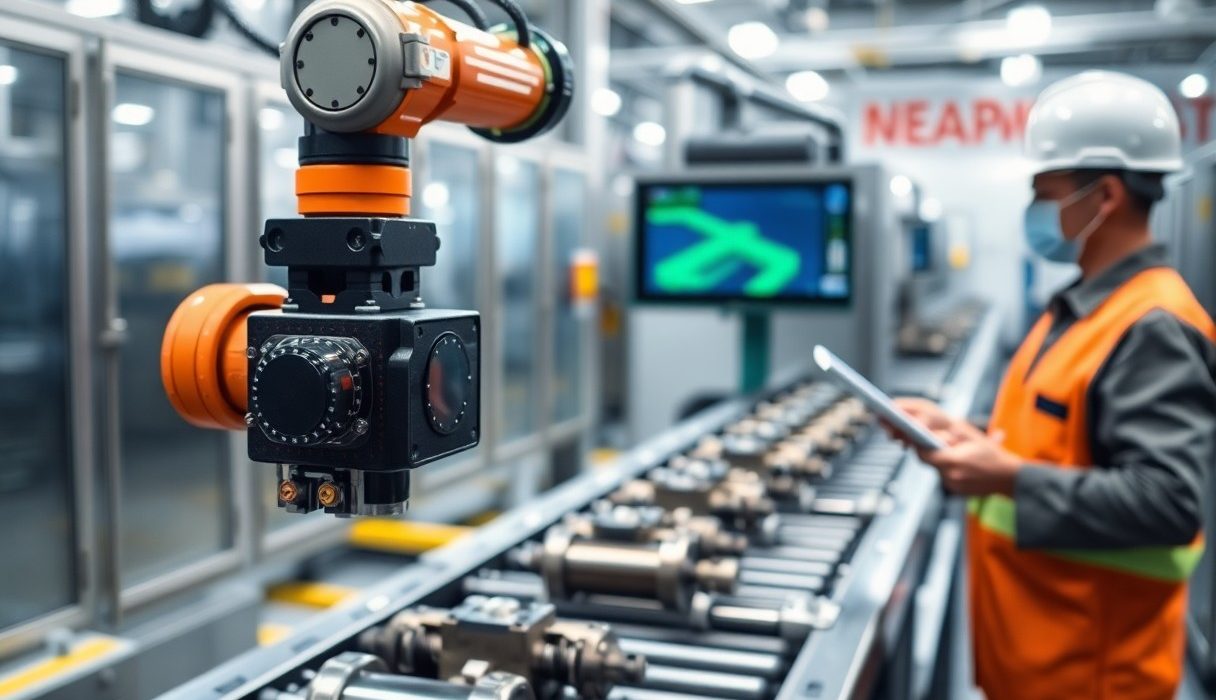
Many industrial settings rely on infrared 3D sensors so you can monitor complex workflows, detect human presence to prevent collisions, and reduce downtime by enabling predictive maintenance. You deploy them for robotic guidance, pallet detection, and quality inspection where high accuracy in dust, smoke, and low light matters and where contact with moving machinery creates serious hazards. Their adaptability helps you improve safety and efficiency while lowering costs.
Types of Infrared 3D Sensors
| Sensor Type | Key Characteristics & Use Cases |
| Active: Time-of-Flight (ToF) | Measures photon round-trip time; typical ranges 0.2-50 m, accuracy from ±1 mm (short range) to ±20 mm (long range), frame rates 30-120 fps; used for bin picking, AGV navigation, and level measurement. |
| Active: Structured Light | Projects coded IR pattern and triangulates depth; high-resolution short-range 0.2-5 m with sub-millimeter to millimeter accuracy; common in inspection and robotic guidance (example: former Kinect v1 deployments). |
| Active: Stereo IR | Two IR imagers compute disparity; robust in reflective environments, lower cost for medium accuracy (mm-cm); useful where ambient IR can be filtered and lighting is controlled. |
| Passive: Thermal / PIR | Detects emitted longwave IR (8-14 μm); provides temperature maps and motion cues, resolutions from 80×60 to 640×480, NETD <50 mK possible; used for predictive maintenance, human detection, and hot-spot localization. |
Active Infrared Sensors
You can deploy Active Infrared Sensors like Time-of-Flight and Structured Light in high-speed lines where you need dense depth maps at 30-120 fps; a typical ToF module delivers ±10 mm accuracy at 2-5 m and tolerates reflective targets when combined with multi-frequency modulation. Examples in industry include robotic pick-and-place that reduces cycle time by 15-30% when switching from 2D to ToF depth sensing, and weld-fixture alignment where structured light delivers sub-millimeter accuracy over short baselines.
Interference and ambient sunlight are practical constraints: you should specify modulation schemes and band-pass optics to maintain SNR, and enforce eye-safety classifications when using laser sources-high-power VCSEL arrays can present eye-safety hazards unless properly rated and controlled.
- Pros: high density depth, fast update, suitable for closed-loop control
- Cons: sensitivity to ambient IR, potential interference between units
- Example: ToF camera on a palletizer reducing mispicks by 40%
Passive Infrared Sensors
When you use Passive Infrared Sensors, including microbolometer thermal cameras and classic PIR motion detectors, you rely on emitted longwave IR rather than active illumination; thermal imagers typically operate in the 8-14 μm band and detect temperature differences down to 20-50 mK NETD, enabling early detection of overheating bearings or electrical faults before visible failure. In process plants you can monitor pipelines and motors remotely; case studies show thermal monitoring can reduce unplanned downtime by up to 30% when integrated with predictive maintenance workflows.
Limitations include coarse geometric detail compared with active 3D systems-thermal sensors rarely produce dense depth maps on their own, so you often fuse thermal with stereo or ToF data to get both temperature and precise geometry. Sensor placement, emissivity assumptions, and occlusions affect accuracy, so you should calibrate emissivity and use known-temperature references for quantitative thermography.
Additional implementation notes: you can pair a thermal camera (e.g., 320×240 @30 fps) with an RGB or ToF sensor to create temperature-tagged point clouds for safety inspections and machine-health dashboards. This
Applications in Industrial Environments
In production lines you’ll find infrared 3D sensors deployed where visual inspection and spatial awareness need to work together: inline metrology, robotic guidance, and worker safety zones. These sensors typically deliver depth maps at resolutions from roughly 320×240 up to 1280×720 and frame rates in the 30-90 fps range, enabling measurement tolerances from sub-millimeter to a few millimeters depending on range and optics. You should plan for environmental effects – bright sunlight, dust, and specular metal surfaces can degrade IR returns, so anti-reflective coatings, active illumination tuning, or multi-view fusion are common mitigations.
When you integrate them, expect high data throughput and low-latency needs: point clouds of 100k-1M points per frame are typical for mid-range systems, and keeping end-to-end latency below 50 ms often determines whether a sensor is usable for dynamic control tasks. Many installations use on-edge GPUs or FPGA preprocessing to extract features and send compact pose or defect data to PLCs over EtherNet/IP, PROFINET or ROS interfaces; the most positive outcomes come when perception is treated as a real-time subsystem rather than an offline analysis step.
Quality Control and Inspection
For dimensional inspection you’ll use IR 3D sensors to verify tolerances on machined parts, plastic mouldings, and assembled modules. In automotive stamping and injection moulding, for example, you can measure gap/flush and contour deviations to within ±0.2-0.5 mm across a production cycle, and detect surface defects such as dents or sink marks that 2D cameras miss. You’ll often pair 3D scans with CAD models to run automated deviation maps; the output feeds directly into SPC systems so you can quantify process drift in real time.
Speed is a major advantage: inline 3D inspection units commonly achieve cycle times under 1 second per part by using structured-light sweeps or time-of-flight snapshots and parallel processing. Be aware that reflective or dark surfaces can produce sparse depth data; you should plan surface preparation (matting sprays, polarizers) or sensor fusion (laser triangulation plus IR TOF) when you need guaranteed coverage. Also note that some active illumination modules operate near eye-safety thresholds-use appropriate safety interlocks and rated optics when deploying higher-power emitters.
Robotics and Automation
In robotic pick-and-place and bin-picking tasks, you’ll rely on IR 3D sensors for object segmentation, pose estimation, and reachability planning. Typical industrial deployments achieve pick success rates above 90-95% in semi-structured bins by combining a depth sensor with PPF or deep-learning pose predictors, and cycle times of 1-3 seconds per pick depending on gripper dynamics. You should mount sensors to provide overlapping views for occlusion reduction and use synchronized captures to prevent motion blur during fast robot moves.
For collision avoidance and dynamic path replanning, the low-latency depth stream lets you create dense occupancy maps at the control loop level; many systems maintain an internal voxel grid at 10-50 Hz and update trajectories on the fly. If you fail to synchronize sensor input with the robot controller, you risk false-negatives in obstacle detection that can lead to dangerous collisions, so implement watchdogs and hardware-level emergency-stops as part of the perception-control chain.
Algorithmically, you’ll combine classical methods (ICP, RANSAC-based pose fitting) with learned descriptors to handle clutter and deformation: edge devices often run CNNs for segmentation with inference times of 10-50 ms on modern edge GPUs, while CPU-based geometric solvers handle final pose refinement. When you benchmark systems, evaluate both success rate and mean time to recover from mispicks-improvements in perception typically translate into 20-40% reductions in average cycle time across mixed-SKU lines.
Factors to Consider When Choosing a Sensor
When you evaluate an infrared 3D sensor for a production environment, focus immediately on how the device performs under your real-world constraints: thermal cycles, airborne contaminants, electromagnetic interference, and the types of surfaces you’ll scan. Manufacturers often quote depth resolution and range separately-expect Time-of-Flight (ToF) modules to offer working distances from about 0.5-50 m with typical depth noise in the 5-50 mm range at longer distances, while structured light and laser triangulation units can deliver sub-millimeter to millimeter precision at <1-3 m>. You should also compare update rates (30-240+ fps), interface latency (goal <20 ms for real-time control), and certification requirements such as laser class and ingress protection.
- Environmental Conditions – operating temperature, humidity, dust, liquids (IP ratings)
- Surface properties – reflectivity, emissivity, transparency, specular highlights
- Required accuracy and range – absolute error, repeatability, working distance
- Throughput – frame rate, latency, and integration with PLC/robot cycles
- Installation & maintenance – window cleaning, purging, mechanical protection
- Regulatory & safety – laser safety, functional safety (SIL/PL) where applicable
Compare those items against concrete targets: if you run automated assembly where you need ±0.5 mm at 1-2 m, structured light or laser triangulation is typically the right choice; if you inspect large machined parts at 5-20 m, ToF or scanning LiDAR variants are more practical despite larger per-point noise. Test candidate sensors on representative samples-measure repeatability over 1,000 cycles, verify temperature drift across your plant’s min/max range, and log false positives caused by specular aluminum or wet paint. The
Environmental Conditions
You must quantify the production-floor environment: specify the expected operating temperature span (for example -20°C to +50°C for most indoor units, or -40°C to +85°C for extended-range industrial variants), maximum relative humidity, and presence of corrosive gases or heavy particulates such as welding fume. Opt for housings rated IP67 or IP69K when high-pressure washdowns or direct exposure to liquids are part of your cleaning regime, and consider purged enclosures or heated windows when condensation or steam is likely.
Vibration and shock tolerance also matter: if the sensor mounts to a robot arm, require vibration specs (for example 5 g RMS) and shock ratings (50-100 g) in the data sheet, or use remote mounting with rigid bracketing and passive isolation. Electromagnetic environments near high-power motors, inverters, or induction heaters necessitate shielding and compliance with conducted and radiated immunity tests; otherwise you risk measurement spikes and dropout during machine cycles.
Required Accuracy and Range
Decide the target accuracy and range based on the task, not the vendor headline. For high-precision metrology tasks you might require sub-millimeter absolute error and repeatability better than 0.05 mm at 200-800 mm working distances-common for laser triangulation sensors. For robotic palletizing or collision avoidance, you can often accept ±10-20 mm at 3-6 m and prioritize long range and robust point clouds over single-point precision; in those cases a ToF system that provides per-point noise of 10-40 mm is acceptable if it maintains scene completeness.
Also factor in point density and field of view: a 90° FOV ToF camera at 5 m gives sparse sampling compared with a close-range structured-light unit, so if you need surface detail to detect 2-3 mm defects choose higher point density even if that reduces max range. Frame rate requirements tie directly to accuracy in dynamic scenes-higher frame rates reduce motion blur and temporal averaging errors, so specify both accuracy and sampling cadence (for example 120 fps at your operating resolution) when evaluating sensors.
Validate accuracy on your parts using gauge blocks, machined flats, and traceable reference artifacts; perform temperature ramp tests to quantify offset drift and establish recalibration intervals that fit your maintenance windows.
The recommendation is to match sensor specifications to measured process requirements and validate choices on your actual components and line conditions.
Step-by-Step Implementation Guide
Begin by defining measurable goals for the deployment: set target accuracy (e.g., ±1-3 mm), throughput (units per minute), and allowable downtime. Use a site map to mark mounting points and obstruction zones, then allocate budget line items for sensors, mounts, cabling, and software licensing so you can evaluate payback within a defined period (for example, a 12-18 month ROI target on a packaging line processing 120 units/min).
Next, create a phased rollout plan: pilot one cell for 4-8 weeks, validate detection rates >99% under production loads, then scale in 2-4 cell batches. Capture baseline metrics (cycle time, defect rate, false positives per 1,000 inspections) so you can quantify the improvement after each phase and adjust sensor density, frame rates, or processing thresholds accordingly.
Implementation checklist
| Step | Details |
|---|---|
| Site survey | Measure mounting heights, line speeds; note ambient IR sources, reflective surfaces, and temperature range (-20 to 60 °C typical). |
| Sensor selection | Choose ToF for long range (0.5-10 m), structured light for high-res short-range (<1.5 m); check IP rating (IP65-IP67) and laser class (IEC 60825). |
| Mounting & optics | Specify mounting brackets, vibration isolation; set field-of-view overlap 10-20% for redundancy; typical mounting torque 2-5 Nm on fixtures. |
| Power & cabling | Use PoE or 12-24 VDC with surge protection; run shielded Cat6 for Ethernet and ground at a single point to avoid loops. |
| Network & software | Ensure latency <10 ms to PLCs for real-time interlocks; use deterministic protocols (EtherCAT/PROFINET) where required. |
| Calibration | Use a flat calibration target (300×300 mm) or fiducial markers; collect 50-100 frames and compute average depth offset; aim for residual error <1 mm. |
| Validation | Run 1,000+ sample parts across environmental extremes; log false positives and detection misses for tuning. |
| Safety & compliance | Verify laser class and label per IEC 60825; integrate hardware interlocks and LOTO for maintenance. |
| Maintenance plan | Schedule quarterly lens cleaning, annual recalibration, and spare sensor inventory (5-10% of deployed units). |
Planning and Requirements
When you plan, quantify the environment: list expected dust levels, conveyor vibration (mm/s), target surface reflectivity (albedo 0.05-0.9), and lighting flicker from nearby IR sources such as halogen heaters. Specify target detection precision-many assembly inspections require ±1 mm repeatability while pick-and-place guidance may tolerate ±3 mm-so you can pick sensor models with appropriate pixel resolution and noise performance.
Allocate integration resources: assign a controls engineer for PLC/fieldbus mapping, an optics/vision specialist for sensor placement, and a technician for cabling and mounting. For example, a mid-sized line integration typically consumes 80-120 engineering hours for a 4-sensor cell and should factor in 2-3 days of on-site tuning during the pilot phase.
Installation and Calibration
Mount sensors on rigid, vibration-damped brackets and aim to minimize angular offsets; for ToF units keep the sensor perpendicular within ±2° to the primary inspection plane to avoid systematic depth errors. Use anti-vibration mounts when conveyor vibration exceeds 2 mm/s and maintain clear line-of-sight with at least 10-20% overlap between adjacent sensors to prevent blind spots.
Perform a multi-stage calibration: coarse geometric alignment using measured mount coordinates, then fine calibration with a flat calibration plate or a checkerboard fiducial (grid spacing 10-20 mm). Capture a minimum of 50 frames at operational frame rate, compute per-pixel depth bias, and apply a look-up correction; aim for a post-calibration residual of <1 mm across the measurement zone.
Pay attention to safety and verification: confirm the sensor’s laser is labeled and within safe class limits (IEC 60825), lock out power before mechanical adjustments, and validate calibration by running a 1,000-part validation batch across temperature extremes to ensure stability and that false-positive rates remain below your defined threshold (for example, <1 per 1,000 inspections).
Tips for Optimal Performance
To maintain peak uptime and measurement accuracy for infrared 3D sensors in industrial environments, treat environmental control and data hygiene as operational priorities. Typical Time-of-Flight units achieve sub-millimeter repeatability at short range (0.1-1.0 mm within 0.5-2 m) but drift if ambient temperature swings exceed ±5°C or if windows accumulate dust and oil; schedule inspections and thermal stabilization to avoid those issues. When deploying at scale, you should aim for frame rates of 30-60 fps for dynamic processes and keep per-sensor latency below 10 ms for closed-loop safety systems.
- Keep optical windows clean-wipe with lint-free cloth and 70% isopropyl alcohol every 2-4 weeks (weekly in dusty lines).
- Control ambient lighting and reflective surfaces: add matte coatings or polarizers when coherent IR speckle or specular reflections cause false returns.
- Enforce thermal envelopes: mount sensors away from ovens or compressors and use active cooling if operating outside 0-45°C.
- Log and review per-sensor health metrics (temperature, signal-to-noise ratio, return-rate) at least once per shift; automated alerts reduce mean time to repair.
Regular Maintenance
You should create a written maintenance routine that includes cleaning, mechanical checks, and calibration. Clean lenses and protective windows on a fixed cadence-typical production lines clean every 2-4 weeks and more often near conveyors-using non-abrasive wipes; inspect for scratches or condensation that can induce measurement bias of several millimeters. Verify mounting bolts and connector torque (typical M5 sensor mounts at 0.5-1.0 Nm), and check IP seals every 6 months to avoid moisture ingress that can permanently damage internal optics.
Schedule calibration against a certified reference (e.g., a precision planar target or gauge block) quarterly or after any physical shock; for high-precision tasks you may recalibrate monthly. Track drift using simple automated tests – capture a reference scene at start of each shift and flag deviations greater than your tolerance (commonly 0.5 mm to 1.0 mm) so you can correct offsets before they affect production. Replace protective windows when scratches reduce signal return by more than 20% or when anti-reflective coatings wear.
Software and Data Integration
Integrate infrared 3D sensors into your control stack using time-synchronized messaging (PTP or NTP with sub-millisecond sync when possible) and standardized middleware such as OPC UA or ROS for robotics cells. Implement edge filtering to reduce network load – voxel downsampling, statistical outlier removal, and temporal averaging can cut bandwidth by 60-80% while preserving geometry for inspection. When you fuse multiple sensors, use rigid-body calibration and report relative transform matrices; a mismatched transform can introduce systematic location errors of several centimeters across a workcell.
Prioritize firmware and SDK compatibility: unpatched firmware can create functional regressions and, in safety contexts, lead to unexpected behavior that is dangerous. Validate new software builds on a mirrored test cell (5-10% of your fleet) for at least 72 hours to measure error rates and CPU/memory impact before rolling out to production. Successful integrators report a 30% reduction in false positives after implementing combined spatial and temporal filtering tuned to their conveyor speed and target sizes.
Thou implement staged rollouts and automated rollback paths for updates, test on a representative 5-10% subset for 72 hours, and monitor key metrics (latency, frame drop, SNR) to prevent widespread downtime.
Pros and Cons of Infrared 3D Sensors
| Pros | Cons |
|---|---|
| Non-contact measurement enabling wear-free inspection and faster cycle times | Sensitivity to highly reflective or transparent surfaces (metallic chrome, glass) which can produce specular errors |
| Typical accuracy in industrial modules of ±1-3 mm at operational ranges, suitable for assembly and QA | Performance degrades under direct sunlight or strong ambient IR, increasing noise and reducing effective range |
| Real-time 3D point clouds for collision avoidance, bin-picking and robot guidance (frame rates often 10-60 fps) | Trade-off between resolution and frame rate: higher resolution often forces lower fps or greater processing load |
| Compact, rugged housings available (IP65-IP67) for dusty, wet production lines | Multipath and inter-reflection errors in confined geometries can create false geometry unless mitigated |
| Easy integration with PLCs/robot controllers via standard interfaces (Ethernet/IP, ROS, GigE) | Higher system cost and integration effort than 2D vision; requires calibration and occasional recalibration |
| Many devices are eye-safe (Class 1), allowing close-quarters deployment | Some high-power or long-range units require laser-safety measures and regulatory compliance |
| Works in low visible-light conditions – you can inspect nocturnal or enclosed spaces without extra lighting | Limited penetration through smoke, heavy dust or fog – obscurants reduce effective sensing range |
| Enables predictive maintenance and automated quality metrics by producing quantifiable 3D measurements | Generates high data volumes that demand edge preprocessing or higher-bandwidth networks and storage |
| Proven in automotive, logistics, electronics for tasks like gap-and-flush, palletizing, conveyor tracking | Temperature drift and material emissivity differences require thermal compensation or per-material tuning |
Advantages in Industrial Applications
You can significantly reduce human inspection time by deploying infrared 3D sensors where dimensional checks are frequent: for example, gap-and-flush inspection on automotive bodies often relies on ±1-3 mm repeatability to drive inline acceptance decisions, and gantry-mounted ToF units can measure hundreds of points across a panel in under a second. Many manufacturers report that replacing manual gauging with automated 3D capture cuts cycle time and variation, letting you keep throughput targets (e.g., >200 parts/hour) while improving traceability.
Integration is straightforward when you choose sensors with standard outputs; you can stream point clouds or depth maps to your PLC or edge computer using Ethernet/IP or ROS, then run lightweight segmentation and key‑point extraction at the edge to avoid network saturation. In robotic picking, for instance, a 3D sensor with 20-50 mm spatial sampling and 30 fps lets your vision system compute grasp points and reduce failed picks, particularly when paired with machine-learning post-processing trained on your part geometries.
Limitations and Challenges
You must plan for environmental effects: direct sunlight or hot machinery increases background IR and can cut effective range or force lower integration times, which worsens SNR. In practice, many factory deployments limit outdoor-facing sensors to shorter ranges (e.g., <5 m) or use narrow-band optical filters and shielding; otherwise you'll see elevated measurement noise or spurious depth readings that require post-filtering.
Material properties create another class of problems-mirrored, highly specular, or partially transparent surfaces produce invalid returns or ghost points, and emissivity differences across a part can bias depth estimation. To manage this, you should combine IR 3D with polarized illumination, structured-light variants, or complementary sensors (laser triangulation, stereo) and implement per-material calibration tables to maintain consistent dimensional accuracy.
Operationally, also budget for compute and maintenance: dense 3D data at 30-60 fps increases CPU/GPU load and storage needs, and you’ll need periodic recalibration after mechanical shifts or thermal cycles-many plants schedule verification checks daily or weekly depending on tolerance requirements. When safety is a factor, verify the sensor’s laser class; although most units are Class 1 eye-safe, any use of higher-power long-range modules obliges you to implement interlocks and signage per local standards.
Conclusion
With this in mind, you can leverage infrared 3D sensors to transform your industrial processes by enabling high-speed, non-contact measurement, automated inspection, and reliable robotic guidance even in low-light or dusty environments. These sensors help you tighten quality control, reduce scrap, and accelerate cycle times while supporting predictive maintenance workflows that keep equipment uptime high and maintenance costs predictable.
To realize those gains, you should match sensor choice and integration strategy to your specific use cases, account for environmental and calibration needs, and invest in data processing and edge analytics that convert point clouds into actionable decisions. As you scale deployment, prioritize interoperability, cybersecurity, and operator training so your teams can extract consistent value and adapt the technology as production demands evolve.