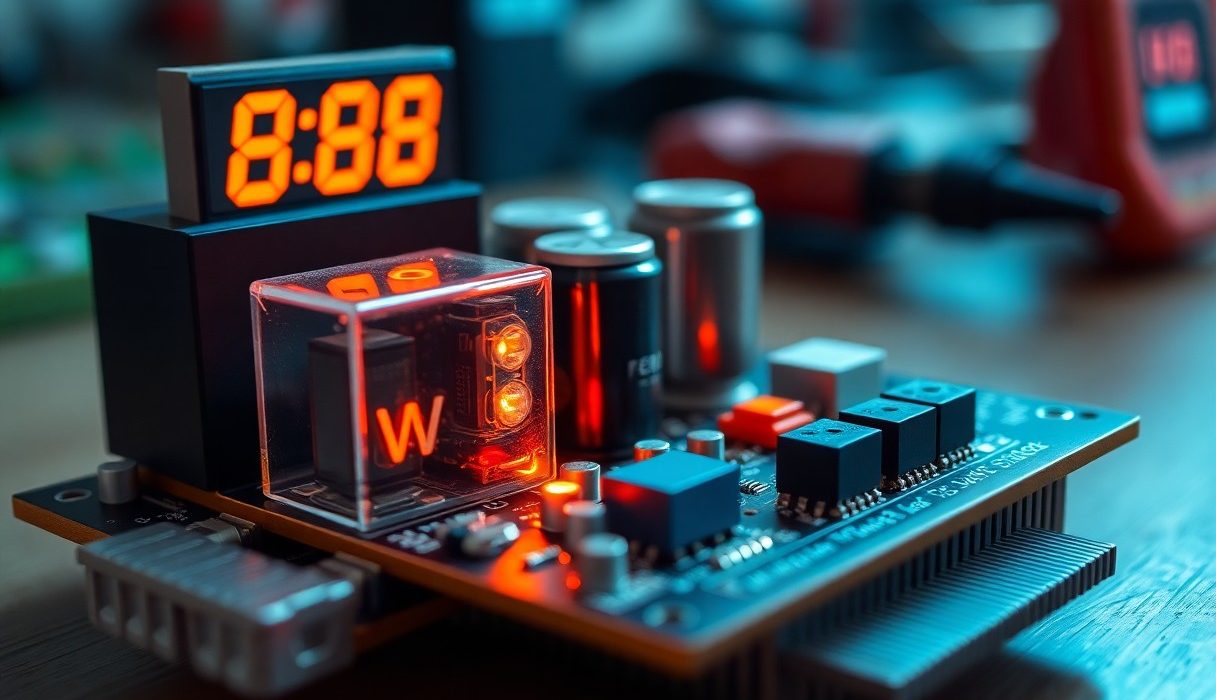
Over the lifecycle of control systems, you will find LED-driven relay designs deliver significant energy savings, lower power draw, and reduced heat generation that minimize thermal stress and fire risk; they also provide longer operational life and improved safety for your installations, enabling you to optimize performance while cutting operational costs and maintenance frequency.
Types of LED Driven Relay Designs
You’ll commonly see three practical families when you analyze LED-driven relay designs: traditional mechanical relays, solid state relays (SSRs), and hybrid or latching variants that optimize hold-time energy. Field data shows a typical 5 V PCB coil relay draws roughly 60-100 mA (0.3-0.5 W) continuously, whereas a latching relay can reduce steady-state hold power to < 20 mW by requiring only a brief pulse to change state.
To compare options for your system you should weigh switching speed, lifetime, thermal management and driver current. For example, switching from a continuously powered coil to an LED-driven latching actuator in a remote sensor network can lower standby energy by more than 80%, while SSRs can eliminate contact wear but introduce heat dissipation concerns at high currents.
- Mechanical Relays – contact-based switching, higher coil power consumption, robust surge tolerance
- Solid State Relays – semiconductor switching, no moving parts, faster cycles
- Latching Relays – pulse-driven hold, very low standby draw
- Hybrid Designs – combine lowest hold power with low on-resistance
- High-current MOSFET SSRs – optimized for continuous loads above 10 A
| Type | Key characteristics / example metrics |
| Mechanical Relay (standard coil) | Typical coil: 5 V @ 60-100 mA → 0.3-0.5 W; life: 10^5 mechanical cycles; susceptible to contact arcing on inductive loads |
| Latching Relay | Bi-stable: pulse to change state (5-50 ms at 0.5-1 W), steady-state hold < 20 mW; ideal for battery-powered systems |
| Solid State Relay (MOSFET) | No moving parts; Rds(on) examples 10-50 mΩ → at 10 A dissipates 1-5 W; fast switching (>kHz), leakage currents of 100s μA |
| Hybrid SSR / Hybrid Relay | Mechanical contact for low R on with semiconductor assistance for arc suppression; typical use when you need low loss plus long life |
Mechanical Relays
When you use LED-driven control to energize a coil, mechanical relays remain attractive because they handle high inrush and provide near-zero on-resistance across contacts (< 10 mΩ when new). A common example-5 V PCB relays like a Songle-style part-draw about 70 mA steady-state; if your application switches infrequently, that continuous coil draw becomes the dominant energy cost and you should measure duty cycle to calculate annual energy use precisely.
In practice you can pair an LED-driven optocoupler or low-side transistor with a snubber and flyback diode to reduce driver losses and EMI; nevertheless, contact wear and arcing on high inductive loads remain the main reliability pain points. If you need long-term energy savings in always-on nodes, swapping to a latching mechanical relay or adding an LED-triggered pulse driver will drastically cut hold-power while preserving the contact advantages.
Solid State Relays
Solid state relays driven by an LED input or photodiode allow you to eliminate mechanical wear and attain switching speeds impossible for contacts-useful when you switch PWM loads or perform rapid load shedding. Typical SSR inputs require 5-20 mA LED drive; you should evaluate input LED current against your controller’s output budget to optimize energy use. For AC SSRs that use TRIACs, be aware of zero-cross behavior and minimum load currents; for DC MOSFET SSRs, pay attention to Rds(on) which directly determines thermal dissipation.
Thermal management is the key tradeoff: at 10 A with a MOSFET-style SSR exhibiting 20 mΩ Rds(on) you’ll dissipate about 2 W (I^2R), requiring a small heat sink or PCB copper pour to keep junction temperatures safe. Also factor in standby leakage-often 100 μA-1 mA-which can matter in low-power or safety circuits and can force you to add bleeder paths or different topologies for fail-safe behavior.
After comparing steady-state coil power, switching losses and lifecycle costs, you can decide whether an LED-driven mechanical, latching or solid state approach best meets your energy and reliability targets.
Tips for Implementing LED Driven Relay Designs
When you convert a control panel or design a new PCB, focus on the electrical relationships: calculate series resistors with R = (Vdrive − Vf)/I (for example, at 24 V with Vf = 2.0 V and I = 10 mA, R ≈ 2.2 kΩ and P ≈ 0.22 W so choose a 0.5 W resistor), and prefer constant-current drivers where supply variation exceeds ±10%. Use a flyback diode sized for the coil’s surge current (select forward current rating > 1.5× coil inrush and reverse voltage > system voltage) for DC coils, and an RC snubber (typical starting point 100 Ω + 0.1 μF) for AC coils to limit dv/dt without killing the indicator LED. Emphasize coil suppression, LED current control, and thermal derating in your BOM to avoid early field failures.
- LED-driven relay
- coil suppression
- current limiting
- latching relays
- RC snubber
- thermal management
Choosing the Right Components
You should select LEDs rated for the forward current you intend to drive-high-efficiency SMD indicators at 5-15 mA give acceptable visibility while minimizing dissipation; for example, moving from a 20 mA indicator to a 10 mA high-efficiency LED halves the indicator power and can yield system savings when scaled to hundreds of points. Pick relays with low coil power or latching mechanisms when switching patterns allow: switching a bank of 10,000 standard 0.6 W coils to 0.06 W latching coils saves about 5.4 kW continuous, a dramatic reduction in facility load.
Pay attention to protection device ratings: choose flyback diodes or TVS devices with reverse standoff above your maximum bus (e.g., >30 V for 24 V systems) and forward/surge ratings above coil inrush. For suppression networks, specify capacitor dielectric types rated to the operating temperature (use X7R or better for 105 °C environments) and resistors with adequate power margin (select at least 2× the calculated dissipation for long life). Highlight maximum LED reverse voltage and coil back‑EMF as potential failure points in your parts checklist.
Ensuring Proper Installation
Wire routing and termination determine real-world reliability: keep low-voltage LED/driver wiring separated from high-current switching runs, use ferrules on stranded conductors, and size conductors to handle coil inrush (for example, use ≥1.5 mm² for continuous currents above 10 A in power traces). Torque terminal blocks per manufacturer specs and validate with a calibrated torque driver; loose terminations are a frequent source of intermittent heating and failure. During commissioning, verify coil currents with a clamp meter and check LED current/voltage under worst-case supply conditions.
Mount relays on PCB land patterns that provide thermal relief and adequate copper pour for heat spreading; if you place many relays in a small area, measure board temperature rise-expect 10-25 °C rise for tightly packed coils-and adjust spacing or add ventilation. For vibration-prone environments, select relays with specified mechanical shock and cycle life (look for >10^6 mechanical cycles for continuous-duty industrial applications), and use retention clips or adhesives where appropriate to prevent contact fatigue. Ensure suppression devices are installed as close as possible to the coil terminals to minimize loop area and EMI.
Perform a focused burn‑in and functional test before field deployment: run assemblies for 24-72 hours at nominal voltage and elevated ambient (for example, +10-20 °C above expected operating environment) while exercising typical switching patterns to reveal solder, connector, and component weaknesses. Record coil pull‑in and drop‑out voltages with an oscilloscope to confirm they fall within the relay datasheet margins, and log any bounce-duration excursions above 5-10 ms that may affect downstream logic. Recognizing these test steps and installation practices will significantly reduce field failures and preserve the projected energy savings.
Step-by-Step Guide to Designing an LED Driven Relay
Design Checklist
| Step | Key actions / examples |
|---|---|
| Define specifications | Set supply voltage (e.g., 5 V or 12 V), relay coil current and switching frequency; target LED drive current (typ. 5-20 mA). |
| Select relay and driver | Choose relay with coil current matching supply (small signal relays: 30-100 mA; automotive relays: 200-400 mA); pick transistor (2N2222/BC337) for ≤200 mA or logic‑level MOSFET for higher currents. |
| Calculate resistors | LED resistor R = (Vsup − Vf)/If; base resistor: Rb ≈ (Vdrive − 0.7)/Ib where Ib ≈ Ic/10 for saturation (example: 72 mA coil → Ib ≈ 7.2 mA → Rb ≈ 620 Ω at 5 V). |
| Suppression & protection | Add flyback diode (1N400x for general use, Schottky for faster recovery), consider RC snubber (100 Ω + 100 nF) if switching speed matters, and include 0.1 µF decoupling at supply. |
| PCB & thermal | Route coil traces for current, place driver close to relay, check MOSFET Rds(on) < 0.1 Ω for low loss, and plan heat dissipation if switching high currents. |
| Testing & validation | Use current‑limited bench supply, measure coil current, verify turn‑on/turn‑off times with oscilloscope, and perform isolation tests if switching mains. |
Initial Planning and Design
Start by quantifying your operating envelope: specify supply voltage, expected ambient temperature, duty cycle, and switching frequency. For example, if you plan a 5 V system with a common SRD‑05VDC relay that draws ~70-90 mA, choose a driver that can handle that continuous current with margin; if the coil current exceeds ~200 mA, plan a logic‑level MOSFET rather than a small signal transistor. You should also define the LED parameters early – typical indicator/driver LEDs run between 5-20 mA with forward voltages of ~2.0 V (red) to ~3.2 V (blue/white) – and calculate series resistors accordingly.
Next, perform component tradeoffs: pick a relay with contact ratings appropriate for your load (e.g., 8 A @ 250 VAC for mains switching, or 1-2 A for low‑voltage signals), and choose suppression strategy based on switching speed. If you need fast release times, use a Schottky or snubber instead of a plain slow diode, since a diode will extend turn‑off time; conversely, if EMI is the bigger concern, an RC snubber or TVS may be preferable. Mark high voltage and mains switching scenarios in your spec sheet and lay out creepage/clearance and isolation accordingly.
Circuit Assembly and Testing
When assembling, mount the relay, driver transistor/MOSFET, and flyback diode close together to minimize inductive loops. Wire the coil so the diode is directly across it (cathode to V+) and place a 0.1 µF decoupling capacitor at the supply pin near the relay driver. During initial power‑up use a current‑limited bench supply set slightly above the expected coil current (for instance, set limit to 150% of calculated coil current) to protect against wiring mistakes; measure actual coil current with your meter and compare to R = V/I to validate coil resistance.
For testing the switching behavior, probe the driver node and coil with an oscilloscope to observe turn‑on and turn‑off waveforms; typical DC coil turn‑on times are milliseconds, but the presence of suppression networks can slow release to tens of milliseconds. Verify that the driver saturates: for an NPN base‑drive example, ensure base current ≈ Ic/10; if you see VCE(sat) > 0.3 V at rated current, increase base drive or switch to a MOSFET to reduce dissipation. Also run a contact endurance test (e.g., 10,000 cycles at your intended load) to confirm thermal and mechanical reliability.
During functional testing pay special attention to back‑EMF and mains isolation – measure voltage spikes during turn‑off, confirm the flyback diode or snubber clamps them below component limits, and when switching AC mains verify isolation with a hipot tester and abide by safety standards; if any spike exceeds component ratings, change suppression strategy or add a TVS and increase creepage distances.
Factors Influencing Energy Efficiency
Several design choices and environmental realities determine how much energy you actually save when using an LED-driven relay. For example, a typical signal relay coil at 5 V may draw 20-50 mA steady-state, while a power relay at 12 V can draw 50-150 mA; pairing those coils with an LED whose forward voltage is 1.8-3.3 V changes how much voltage must be dropped and therefore how much power is wasted in the driver. Practical strategies such as replacing a simple series resistor with a constant-current driver or a low-drop regulator can reduce wasted drive power by roughly 30-60% in 12-24 V systems, and choosing a latching relay can eliminate continuous coil hold losses entirely in many applications.
- Coil current – steady-state and inrush (inrush can be 2-3× steady-state) determine average energy use.
- Driver topology – series resistor vs constant-current vs PWM heavily affects dissipation.
- Duty cycle – intermittent actuation (10-50% typical in control systems) multiplies into energy savings potential.
- LED forward voltage and color – Vf variance (≈1.8-3.3 V) changes headroom and resistor losses.
- Ambient temperature and thermal path – component temperature coefficients shift currents and reliability.
Thou must measure the coil current, duty cycle, and actual Vf of the LED in your final enclosure to validate modeled savings and ensure the relay still meets pick-up and drop-out specifications.
Load Characteristics
You should treat the relay coil and the load it switches as two separate but interacting contributors to efficiency: the coil’s steady-state current and its inrush define the energy the driver must supply, while the switched load determines how often the coil is energised. In practice, many small signal relays draw 20-50 mA at 5 V while medium power relays draw 50-150 mA at 12 V; if your system experiences frequent switching, inrush currents 2-3 times the steady value will dominate switching losses and require you to size drivers and fuses accordingly.
You can employ several tactics to reduce energy impact of the load characteristics: use latching relays or mechanical detents to remove continuous-hold consumption (latching designs can cut steady-state coil energy by >90%), implement PWM or burst-drive to reduce average coil current while preserving pull-in energy, and add current sensing so your firmware can back off drive when full force isn’t needed. When you design for actuators or solenoids with known duty cycles-typical HVAC valves might be energized under 30% of the operating period-these measures compound into measurable system-level savings.
Ambient Conditions
Temperature shifts change both the coil resistance and the LED characteristics: copper’s temperature coefficient is ≈0.4%/°C so a ±20°C swing can alter coil resistance ~8%, and many LEDs have a Vf temperature coefficient around -1.5 to -4 mV/°C so Vf can change by ~30-80 mV over the same range. That means a voltage-driven coil in a hot enclosure may see reduced current and weaker pull-in, while the LED will draw differently and shift where the driver dissipates power-factors that force you to derate or redesign drive electronics for the expected operating temperature.
Humidity, enclosure ventilation, and proximity to heat sources also matter: sealed boxes without convection can raise internal temperature 10-30°C depending on dissipation, increasing coil and driver losses and accelerating component aging. You should therefore specify components with operating ranges (for example -40 to +85°C) and model worst-case internal temperatures when estimating energy and reliability.
More detailed thermal planning-like adding a 1-2 W heat path, placing the LED/driver on the cooler side of the board, or using a small heatsink for high-duty drivers-lets you keep thermal resistance low and maintain predicted efficiency across seasonal extremes while preserving relay performance.
Pros and Cons of LED Driven Relay Design
When you evaluate LED-driven relay architectures, weigh the measurable energy savings against practical system trade‑offs: replacing a 24 V coil that draws 50 mA with an LED/photodiode drive at 5 mA saves ~45 mA per channel, which across 100 channels equates to a 4.5 A reduction in control supply load and several watts less dissipation. You should also factor thermal management: less coil power cuts enclosure temperature rise by a predictable margin (for example, a 10 W reduction in panel dissipation can lower ambient by ~3-5 °C depending on ventilation), which extends component life and lowers cooling needs.
At the same time, you must account for application limits: LED‑activated optocouplers and solid‑state relays introduce off‑state leakage (typically 1-10 mA), can have higher on‑resistance for large inrush loads, and are sensitive to ambient temperature and LED ageing. For instance, if your design switches resistive heaters, that leakage can cause micro‑heating or nuisance operation unless you add bleed resistors or snubbers; factor these mitigation parts into the net cost and power budget.
Pros and Cons at a glance
| Pros | Cons |
|---|---|
| Significant input power reduction (typical 50-90% lower than electromagnetic coils) | Off‑state leakage current (often 1-10 mA) can affect low‑power loads |
| Lower heat generation in control panels → reduced cooling requirements | Limited ability to handle high inrush currents without additional components |
| Smaller driver components and PCB footprint (saves board area) | Higher unit cost for some SSR/opto packages versus basic mechanical relays |
| Longer operational life for solid‑state implementations (no mechanical wear) | Degraded LED output over time requires derating/compensation |
| Better isolation options via optocouplers for safety and EMI control | Temperature sensitivity of LED forward voltage affects trigger thresholds |
| Fast switching possible (ms to μs range for solid‑state) | Some SSRs produce switching noise or EMI requiring filtering |
| Easy integration with low‑power microcontroller GPIOs (direct drive) | Reverse polarity and surge protection still needed for reliability |
| Predictable, repeatable activation current simplifies power budgeting | Not always suitable for AC mains switching without appropriate SSR type |
Advantages of Using LED Relays
You gain measurable efficiency: by driving the relay input with an LED/photodiode arrangement you typically drop coil consumption from tens of milliamps to single‑digit milliamps, which directly reduces supply sizing and battery draw in backup systems. For example, replacing ten 50 mA coils with LED drivers at 5 mA each cuts the control bus current from 500 mA to 50 mA, freeing capacity for other loads or enabling smaller power supplies.
Implementation also improves reliability and maintenance intervals because solid‑state LED‑activated devices eliminate mechanical contact wear and contact corrosion. In continuous‑duty industrial installations where mechanical relay MTBFs might be on the order of 10^5 cycles, an LED‑driven solid‑state option can extend operational life to >10^8 cycles, reducing downtime and spares inventory.
Disadvantages and Limitations
LED‑based relay drives introduce leakage and on‑resistance constraints that you must mitigate: many SSRs leak 1-10 mA when off, and on‑state resistance can cause voltage drop and heat at high currents. If you switch loads with large inrush (motors, solenoids), you will need snubbers, bypass relays, or hybrid switching (mechanical contacts for high current, SSR for control) to avoid excessive dissipation or false trips.
Thermal and ageing effects also affect threshold and performance-LED forward voltage shifts roughly -2 mV/°C per diode and luminous output declines by a few percent per thousand hours depending on current and temperature, so you must design for derating or closed‑loop sensing. In safety‑critical circuits, those shifts can demand additional monitoring or redundancy, increasing system complexity and cost.
Finally, EMI and compatibility considerations matter: switching waveforms from SSRs can generate dv/dt that triggers upstream sensing or causes EMI; in one retrofit case study replacing 200 mechanical relays with SSRs, engineers added RC snubbers and common‑mode chokes and saw EMI mitigation parts add ~5-10% to BOM cost but resolved nuisance trips. You should budget for similar suppression and validation when you convert designs.
Future Trends in LED Relay Technology
Emerging wide-bandgap semiconductors and low-power LED driver ICs are reshaping relay front-ends: by replacing conventional silicon switching and bulky holding coils with GaN transistors and precision LED current sources, you can expect switching losses to drop and switching speeds to rise, enabling PWM control at >500 kHz in some designs and reducing overall control-panel energy draw by a noticeable margin. At system level, manufacturers report that adopting LED-driven latch schemes and integrated low-voltage drivers can cut steady-state coil/holding power by roughly 50-80% compared with legacy continuous-coil relays in typical HVAC and lighting control panels.
Parallel trends toward miniaturization and modularity mean you’ll find relay modules with built-in diagnostics, current sensing, and galvanic isolation in a single package, removing the need for separate optocouplers or discrete sensors. As solid-state and hybrid relays gain traction, analysts project continued double-digit adoption in industrial and building automation over the next 5-7 years, driven by energy regulations and the push for predictive maintenance capabilities integrated into field devices.
Innovations in Design
You’ll increasingly see adaptive-drive topologies where the LED drive current is dynamically adjusted by an MCU based on load conditions, temperature, and wear indicators; integrating an ARM Cortex-M0+ or similar controller with an onboard 12-bit ADC enables you to implement closed-loop control that reduces average LED current to the minimum required for reliable switching. Manufacturers are already shipping modules that combine a microcontroller, GaN FET switching, and current-sensing shunt on a single small PCB, which both saves space and lowers parasitic losses that used to waste energy in wiring and connectors.
Design innovations also tackle reliability: stacking thin-film thermal vias, using localized heat-spreading materials, and embedding current-limiting algorithms prevent thermal runaway in densely packed assemblies. For example, some OEMs report mean-time-between-failure (MTBF) improvements of >2x after adopting active current limiting and temperature derating in LED-driven relay modules, making these solutions attractive where both energy efficiency and uptime matter.
Integration with Smart Systems
When you integrate LED-driven relays into smart systems, the immediate gains are in visibility and control: onboard metrology (1-4 MSPS ADCs for transient capture, or simpler 1 kS/s for steady-state monitoring) lets you log coil current, switching events, and contact health to a gateway using Modbus, BACnet, CAN, or MQTT over TLS. That data lets you set thresholds that trigger local PWM reductions or full circuit bypassing to extend relay life, and you can reduce unplanned maintenance by detecting contact degradation or increasing inrush signatures before failure.
Networked relays also enable demand-response and load-shedding strategies: you can orchestrate groups of LED-driven relays to stagger switching and reduce peak inrush currents, cutting peak facility loads and often lowering utility demand charges. In practice, integrating relays with building management systems has been shown to reduce facility peak by coordinating switching ramps and using predictive control heuristics based on historical switching patterns.
On the security and operations side, you should implement secure boot, signed firmware, and encrypted telemetry (AES-128/256 or TLS 1.2+) for remote management; industry standards such as IEC 62443 provide a baseline for hardening. In addition, edge analytics running on the relay module can compress and pre-filter data-sending only anomaly events-so you limit bandwidth and exposure while still enabling cloud-based trend analysis and OTA firmware updates that preserve both reliability and security.
To wrap up
Ultimately you gain measurable energy savings when you choose LED-driven relay designs: lower coil currents, reduced holding power, and more efficient driver circuitry cut both active and standby consumption. You also reduce thermal losses and improve component longevity, so your relays maintain performance with less energy wasted over the product lifetime.
By adopting LED-driven relay solutions you enable finer control strategies (PWM, dimming, feedback) and faster switching that further trims system-level losses, lowers maintenance and replacement costs, and shortens payback periods-making your installations more energy-efficient and resilient.