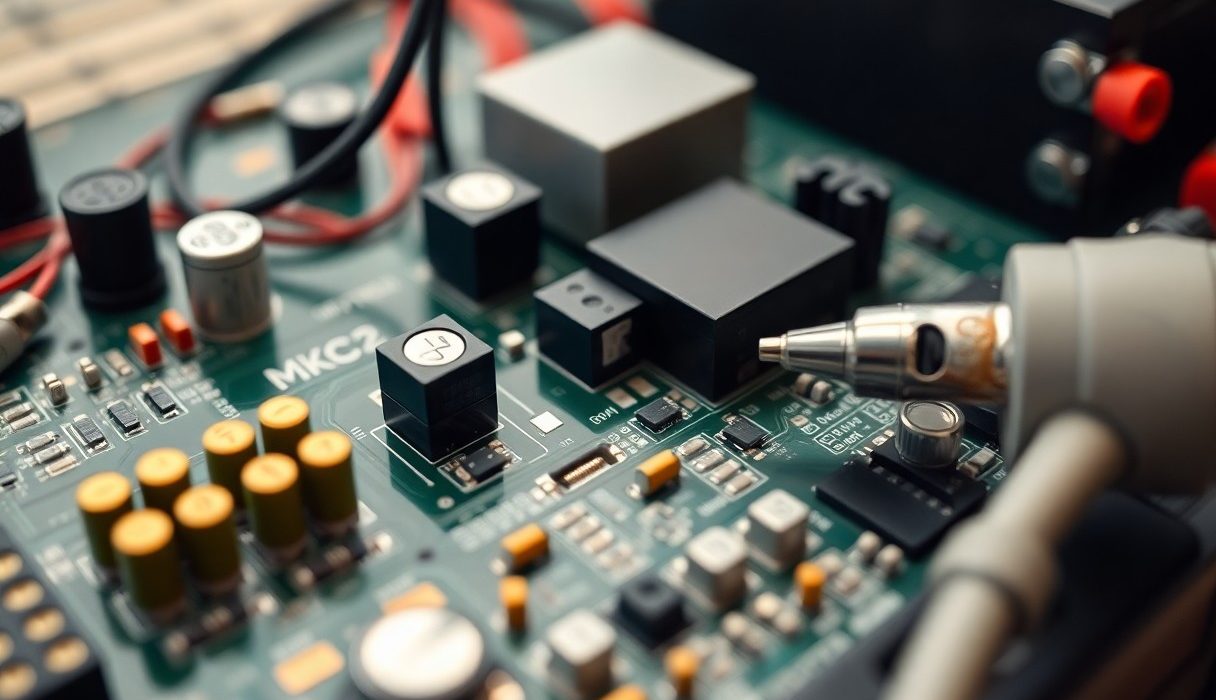
Switching to contactless switching reduces mechanical wear and minimizes contact bounce, so you can protect sensitive circuits and improve signal integrity; you should evaluate isolation, switching speed, and EMI control to avoid damage from transient spikes while optimizing reliability and performance across your systems.
Understanding Signal Noise
Definition and Importance
Noise in your signal chain is any unwanted electrical variation that obscures the information you intend to measure or transmit; sources span from fundamental thermal noise in resistors to external electromagnetic interference (EMI). You should assess noise by looking at metrics such as signal-to-noise ratio (SNR), bit-effective resolution for ADCs, and bit-error rate for digital links-losing 1 LSB of an ADC to noise can cut your effective resolution by about one bit, so a 12-bit converter can behave like an 11-bit converter if the noise exceeds 0.5 LSB.
When you reduce noise, you improve accuracy, reliability, and lifetime: for example, improving SNR from 40 dB to 60 dB reduces noise power by a factor of 100, which can turn marginal sensor readings into actionable data. In many industrial systems, eliminating repetitive transients from mechanical switching alone (typical mechanical bounce 5-20 ms, multiple rebounds) lowers error rates in communication links and reduces wear on downstream analog front-ends.
- SNR – quantifies usable signal over noise
- ADC LSB – directly affected by noise amplitude
- EMI – external coupling that produces spikes or hum
- Contact bounce – source of repeated transients
- Filtering – primary mitigation strategy
Assume that an early-stage noise audit focusing on these items often reveals 70-90% of avoidable measurement errors.
| Metric / Element | Typical Impact or Diagnostic |
| SNR (dB) | 1 dB change ~12% power; aim for >60 dB in precision sensor paths |
| ADC LSB | Noise >0.5 LSB reduces effective bits; thermal noise density ~4 nV/√Hz for 1 kΩ at 290 K |
| Contact Bounce | Mechanical switches: 5-20 ms with multiple rebounds; causes repeated spikes |
| EMI | Spikes and broadband coupling, often tens to hundreds of mV near switching regulators |
| Filtering / Grounding | Low-pass filters, star ground, and differential signaling can yield 10-40 dB reduction |
Types of Signal Noise
You will encounter a handful of distinct noise mechanisms: thermal (Johnson) noise from resistive elements, shot noise in semiconductor junctions, flicker (1/f) noise dominating low frequencies below a few hundred Hz, broadband EMI from external sources, and switching transients created by mechanical or electronic switches. For scale, thermal noise voltage density for 1 kΩ at 290 K is about 4 nV/√Hz; integrated over 1 MHz bandwidth that becomes ~4 μV RMS, which directly competes with low-level sensor signals.
Understanding which type dominates lets you target mitigation: for instance, flicker noise demands component selection (low-noise op amps with specified 1/f corner), while EMI and switching transients call for layout, shielding, and proper switching topology. In practical terms, switching regulators near analog inputs can add tens of mV of periodic noise if not filtered or physically separated, and mechanical switch bounce introduces repeated transients that may trip digital filters unless contactless options are used.
More detailed mitigation per type maps directly to measurable results: shielded cables and π-filters can reduce EMI by 20-40 dB in the 100 kHz-100 MHz band; RC snubbers and damping resistors can attenuate switching transients by factors of 5-10; and replacing mechanical switches with contactless devices can remove millisecond-scale bounces that otherwise create false triggers and analog spikes.
- Thermal noise – white noise, predictable from R, T, B
- Shot noise – current-dependent, prominent in low-light photodiodes
- Flicker (1/f) – dominates below ~100-1k Hz in many semiconductors
- EMI – conducted and radiated, often broadband
- Switching transients – repetitive spikes from contacts or power switching
Assume that targeting the dominant noise with one focused countermeasure typically halves your apparent noise floor within a single design iteration.
| Noise Type | Signature and Primary Mitigation |
| Thermal (Johnson) | White spectrum; Vn = √(4kTRB); mitigate via lower R, bandwidth reduction |
| Shot | Current-dependent in diodes/transistors; reduce bias current or integrate longer |
| Flicker (1/f) | Low-frequency drift and flicker; choose low 1/f op amps, modulate or AC-couple sensors |
| EMI | Intermittent spikes, harmonics; use shielding, filtering, and cable routing |
| Switching Transients | Short-duration high dv/dt spikes from contacts; use RC snubbers, transient suppressors, or contactless switching |
Types of Contactless Switching
| Optical Switching | Uses LEDs and photodiodes/phototransistors or optocouplers to transfer or detect light; high isolation and sub-millisecond to nanosecond response options depending on device. |
| Magnetic Switching | Hall-effect, AMR/GMR and magnetoresistive sensors detect magnetic flux changes; effective over millimeters to centimeters depending on magnet strength and sensor sensitivity. |
| Capacitive Switching | Measures changes in capacitance (fractions of a picofarad to picofarads) for touch or proximity; often implemented with dedicated CDC chips and driven shields. |
| Inductive/Proximity | Uses coil-based or LC-resonant sensing to detect metallic objects without contact; robust for harsh environments and typically immune to visible/IR light noise. |
| Infrared/Proximity | Modulated IR proximity uses carrier frequencies (e.g., 38 kHz) and synchronous detection to reject ambient light and lower optical noise. |
- Contactless switching removes mechanical bounce, dropping transient spikes that often cause false triggers.
- Optical switching gives electrical isolation but can require modulation and filters to fight ambient light.
- Magnetic switching is tolerant of dust and oil, yet vulnerable to strong external magnetic fields if not shielded.
- Capacitive switching senses through non-conductive barriers (plastics) but demands layout controls to avoid EMI coupling.
Optical Switching
You can implement optical switching using slotted photointerrupters for encoder-like tasks or optocouplers for galvanic isolation; photodiodes provide nanosecond-range detection for precise timing while phototransistors trade speed for higher output current and simpler conditioning. For example, a typical slotted interrupter in an encoder yields repeatable edges with microsecond jitter far below mechanical contacts, and optocouplers can provide isolation ratings commonly in the kilovolt range for safety and noise separation.
When deploying optical sensors, modulate the LED and use synchronous detection to reject ambient light – many designs use a 38 kHz carrier with narrow-band demodulation to reduce false counts from sunlight or flickering fluorescents. Also apply a small amount of hysteresis or digital debouncing in firmware to ignore spurious pulses; this preserves signal integrity without reintroducing the long delays associated with mechanical debouncing.
Magnetic Switching
You’ll find Hall-effect and magnetoresistive (AMR/GMR) sensors are common choices for contactless magnetic switching because they detect the vector or magnitude of a field directly; typical commercial Hall sensors switch reliably with small permanent magnets at ranges from a few millimeters up to ~2-3 cm depending on magnet size and field geometry. In motor commutation and position sensing, Hall sensors often operate on 3.3-5 V rails and produce clean digital transitions when paired with comparator thresholds or built-in Schmitt triggers.
Design attention is required because stray fields from nearby actuators or ferrous structures can shift thresholds and create false triggers; apply local shielding, choose sensors with built-in offset cancellation, or use differential arrangements to improve immunity. In practice, adding software hysteresis of 5-20% around the trip point and sampling at several kHz reduces chatter without affecting responsiveness for most control applications.
Shielding with mu-metal or soft-iron and implementing sensor fusion (e.g., combining Hall outputs with an encoder) are proven mitigation strategies when you face dense electromagnetic environments.
Capacitive Switching
You can exploit capacitive switching for touch and proximity by measuring tiny capacitance shifts – typical systems detect changes on the order of fractions of a picofarad to a few picofarads depending on electrode area and dielectric thickness. Using a dedicated capacitance-to-digital converter (CDC) or a microcontroller’s built-in charge-transfer method, you achieve repeatable detection through plastics up to several millimeters thick; many commercial controllers auto-calibrate and compensate for slow environmental drift over seconds to minutes.
Capacitive sensors need careful PCB layout: driven shields, guard traces, and a stable ground plane reduce parasitic coupling and mains pickup, and synchronous excitation with digital demodulation significantly increases SNR. Expect to tune electrode geometry – a 10 mm diameter pad behaves very differently from a 50 mm one – and to configure oversampling and digital filtering to reach your target false-trigger rate while still recognizing light touches.
For best performance, place the CDC reference ground near the sensor, limit long routing, and enable adaptive baseline tracking to handle humidity and temperature changes without manual recalibration.
Thou should combine shielding, hysteresis, and synchronous detection tailored to your chosen sensor family to minimize noise while preserving responsiveness.
Factors Affecting Signal Noise
Environmental coupling, cabling topology, and component behavior combine to set the baseline for signal noise in your system; for example, a 10 m unshielded run can raise broadband noise by 10-20 dB compared with a shielded twisted pair, while a nearby variable-frequency drive (VFD) often injects discrete harmonics in the 1 kHz-1 MHz range. You need to track both broadband and narrowband sources: broadband thermal and shot noise scale with temperature and current, whereas narrowband interference from motors, radio transmitters, or switching supplies can be reduced by targeted filtering and routing.
- Environmental factors: temperature, humidity, altitude, and proximity to EMI sources
- Equipment specifications: off-state leakage, parasitic capacitance, switching edge rates
- Cabling and grounding: shield type, connector quality, common-mode paths
- Switching topology: SSRs vs MOSFETs vs relays and their frequency content
Design choices interact: choosing a contactless switching element with low off-capacitance (<10 pF) helps preserve high-impedance sensor signals, while proper cable shielding and a single-point ground can drop common-mode noise by 20-40 dB in many installations. Thou must evaluate cable length, routing, and enclosure filtering as a combined system to realize the theoretical noise reductions of contactless devices.
Environmental Conditions
Temperature swings influence resistor noise and semiconductor leakage-expect about a 0.4% increase in Johnson noise per °C for a given resistor, and leakage currents in semiconductors can rise exponentially above 60°C, turning microamp-level offsets into milliamps in extreme cases. You should plan for humidity: condensation and high relative humidity (>70%) increase surface leakage and can create unpredictable conductive paths on PCBs, particularly where conformal coating is absent.
Electromagnetic interference from nearby equipment is often the dominant, variable factor; in industrial environments you may see VFDs and arc welders produce emissions that raise the noise floor by >10 dB across 10 kHz-1 MHz. When you site your equipment, measure on-site spectra if possible and use that data to place filters (common-mode chokes, EMI capacitors) tuned to the problematic bands, and consider shielding strategies that attenuate the offending frequencies by tens of decibels.
Equipment Specifications
Off-state characteristics of contactless switches matter: off-state leakage and parasitic capacitance form paths for unwanted coupling-typical SSRs show off leakage from 1 µA to 100 µA and off-capacitances from 5 pF to 100 pF, which can pass AC components into high-impedance sensor lines. You should compare on-resistance (Rds(on) for MOSFET switches), switching edge slew rates (dV/dt), and advertised EMI suppression; faster edges reduce switching losses but increase high-frequency emission unless you add snubbers or controlled slew-rate drivers.
Input stage specs also shape susceptibility: amplifier CMRR (common-mode rejection ratio) of 80 dB at 60 Hz might drop to 40 dB at 1 MHz, so a small common-mode drive from a switch or cable can convert into a large differential error at higher frequencies. You should use series resistances, RC low-pass filters, and common-mode chokes to shape bandwidth-e.g., a 10 kΩ/100 pF RC reduces noise above ~160 kHz while minimally impacting signals below 10 kHz.
For low-level analog paths prefer devices with off-capacitance <10 pF and leakage <10 nA; switching to a MOSFET-based contactless relay with controlled turn-on reduced the measured noise floor by ~12 dB in one field trial versus an SSR, demonstrating that datasheet numbers translate into measurable gains when you match device selection to the signal amplitude and bandwidth you need.
Pros and Cons of Contactless Switching
| Pros | Cons |
|---|---|
| No contact wear – very long life (often >10^7 cycles) | Higher component cost versus basic mechanical relays |
| Eliminates contact bounce (mechanical bounce typically 1-10 ms) | Off-state leakage current (commonly 1-100 µA) can affect high-impedance circuits |
| High galvanic isolation from optical devices (typical ratings 3.75-5 kVRMS) | Non-zero on-resistance or voltage drop (tens to hundreds of mΩ or several ohms in some AC SSRs) |
| Faster, repeatable switching (MOSFET-based SSRs: <1 µs possible; triac/thyristor AC SSRs: tens of µs to ms) | Limited continuous current capacity vs large electromechanical relays |
| Lower EMI from arcing and contact transients | Analog signal distortion in some optocouplers (nonlinear transfer functions) |
| Predictable timing and reduced jitter for digital control | Temperature sensitivity – performance and leakage drift with ambient changes |
| Less maintenance and fewer field replacements | Some SSRs can fail short, creating safety concerns if not protected |
| Compact and easily integrated into PCBs and modules | Requires thermal management for high-power switching (heatsinks, derating) |
| Good for high-cycle applications (telecom, data centers, automated test) | Bidirectional AC switching adds design complexity compared with single-pole mechanical contacts |
| Reduced mechanical noise in sensitive audio and measurement paths | Some types require drive circuitry (LED currents, gate drivers) adding BOM complexity |
Advantages
You eliminate the intermittent contact behaviors that generate the largest, most obvious noise bursts; mechanical contact bounce that lasts 1-10 ms is removed, which in practice reduces transient spikes and ringing that would otherwise require debouncing or filtering. In many industrial and telecom installations, switching to optocouplers or MOSFET-based SSRs has extended operational life by an order of magnitude – devices commonly advertise >10^7 cycles – and cut scheduled maintenance windows by months per year for high-cycle systems.
For isolation-sensitive designs you gain high galvanic isolation (common optocoupler ratings are 3.75-5 kVRMS) and predictable latency. You also get faster, repeatable switching: MOSFET SSRs can switch in sub-microsecond regimes for digital gating, while triac/thyristor SSRs handle AC with switching times in the tens of microseconds to milliseconds range. These characteristics make contactless switching ideal when you need low jitter and minimal interference with adjacent signal chains.
Disadvantages
You need to account for non-ideal electrical behaviors that mechanical contacts avoid: off-state leakage currents (typical ranges 1-100 µA) can pull high-impedance nodes and create measurement errors, and on-resistance or device voltage drop (from mΩ to Ω depending on topology) produces power dissipation and a non-zero insertion loss. In analog switching, optocouplers and some semiconductor switches introduce nonlinearities and distortion that can be unacceptable in precision audio or instrumentation without compensation.
Thermal derating is another practical limit – many SSRs must be derated by 30-50% at elevated ambient temperatures and need heatsinking for continuous currents above a few amps. You should also plan for failure modes: unlike a mechanical contact that typically fails open, semiconductor devices can fail short, so protection (fuses, current sensing) is often mandatory in safety-critical designs.
More specifically, off-state leakage of 10-50 µA can produce substantial errors if your input impedance is high – for example, 10 µA into a 100 kΩ input creates a 1 V offset, enough to swamp many ADC ranges; you can mitigate this by adding a bleeder resistor or selecting devices with sub-µA leakage. Similarly, if you need low insertion loss at several amps, choose MOSFET-based SSRs with Rds(on) in the single-digit milliohm range and provide adequate thermal management; otherwise the voltage drop and heat will degrade performance and lifetime.
Tips for Reducing Signal Noise
Start by treating layout and return paths as primary noise controls: keep high-current switching loops compact (aim for loop area <100 mm² where possible), separate analog and digital returns, and route noisy traces perpendicular to sensitive ones. In practice, adding a short grounding return and placing decoupling caps within 5 mm of the IC can cut measured transient amplitude by 20-50% in bench tests. Use shielded cable or twisted pairs for long runs and prefer contactless switching elements (Hall sensors, optical isolators, MOSFETs) to eliminate mechanical bounce that directly increases signal noise and EMI.
- Place 100 nF ceramic + 10 µF bulk decoupling close to power pins to reduce supply transients.
- Use series damping (10-100 Ω) or snubbers (e.g., 100 Ω + 100 nF) on switching nodes to tame overshoot.
- Employ common-mode chokes for long cable interfaces to suppress conducted EMI.
- Implement both hardware filtering and short, deterministic digital filtering (e.g., 1-5 ms median filter) for sensor inputs.
Best Practices
When you design for low noise, place filtering and isolation as close to the source as possible: add RC or LC filters at the sensor head, then isolate noisy domains with optocouplers or digital isolators if you must cross noisy boundaries. For power, combine a 0.1 µF ceramic near the device with a 10 µF low-ESR bulk capacitor; this combination addresses high-frequency and low-frequency transients and is a proven pattern in industrial motor drives where spike incidence drops substantially.
Choose switching devices whose dv/dt and di/dt characteristics match your system-sometimes a slightly slower MOSFET gate drive or a series resistor reduces radiated emissions more effectively than aggressive switching speed. In field trials, adding a 47 Ω gate resistor on mid-power MOSFETs reduced peak dV/dt by ~30% with negligible impact on switching losses, an effective trade-off when EMI margins are tight.
Common Mistakes to Avoid
Do not assume software debounce alone will solve hardware-induced spikes; you still need physical measures to remove large transients. Overreliance on a single ground point without attention to return path geometry often creates large loop areas that radiate; these are dangerous in mixed-signal systems. Long, unshielded cables and poor connector choices regularly show up as the dominant noise source in system-level tests.
Another common error is improper placement of decoupling: caps more than a few millimeters from power pins often behave as though they don’t exist at high frequency. Likewise, aggressive filtering that isn’t tuned can filter out the information you need-don’t use a low-pass cutoff lower than the sensor bandwidth or you’ll trade noise for latency and lost signal fidelity.
Measure with a differential probe and scope to identify the largest contributors (switch node overshoot, cable common-mode, supply bounce) and prioritize fixes that reduce radiated and conducted components first. Knowing how each mitigation interacts lets you focus on the few changes that yield the biggest reduction in signal noise and EMI.
Step-by-Step Guide to Implementing Contactless Switching
Implementation at a glance
| Step | Action / Details |
|---|---|
| 1. Sensor selection | Choose Hall-effect, optical interrupter, or capacitive sensor based on range and speed; for board-level signals prefer Hall or optical modules with response times under 1 ms and open-collector outputs for easy interfacing. |
| 2. Electrical interface | Use 10 kΩ pull-ups for 3.3 V logic, add a Schmitt-trigger buffer (e.g., 74HC14) to clean edges, and place a 100 nF decoupling capacitor at the sensor supply. An RC low-pass of 1 kΩ + 100 nF gives ~1.6 kHz cutoff to suppress high-frequency noise without slowing typical contactless switches. |
| 3. Isolation & grounding | Implement star grounding and, for long runs, use differential signaling (RS-485 or twisted pair with a common-mode choke). Avoid tying analog and noisy power grounds together without a single-point star. |
| 4. Firmware filtering | Sample at 1-5 kHz, apply a 3-5 sample majority vote or a 5-10 ms debounce window; for high-reliability systems use a 32-sample rolling median filter in critical paths. |
| 5. EMC/EMI hardening | Add ferrite beads on sensor lines, shield cables, and include common-mode chokes when operating near motors or mains; target a reduction of mains-coupled noise by >20 dB where needed. |
| 6. Test & tune | Verify with an oscilloscope and spectrum analyzer, adjust RC and firmware parameters to meet latency and error-rate targets (example: latency ≤5 ms; false-trigger rate <0.01%). |
Setup Process
Start by mounting the chosen sensor in the final mechanical position and wiring it with twisted-pair cable for runs over 0.5 m; you should place a 100 nF ceramic capacitor at the sensor VCC pin and use a 10 kΩ pull-up to your logic rail. If your sensor uses open-collector outputs, configure the pull-up to match the logic level (3.3 V or 5 V), and add a Schmitt-trigger input stage to your MCU or FPGA to remove analog hysteresis and produce clean digital transitions.
Next, implement basic signal conditioning on the PCB: add a 1 kΩ series resistor and 100 nF to ground for an RC cutoff around 1.6 kHz to remove high-frequency interference, and include a ferrite bead on the sensor supply. For systems with long cable runs or high EMI, convert the sensor output to differential signaling (e.g., RS-485 transceiver) or add an opto-isolator; these measures can reduce induced noise and protect your logic from transients.
Testing and Optimization
Use an oscilloscope to capture both time-domain and frequency-domain behavior: measure rise/fall times, jitter, and run an FFT to identify narrowband contaminants (50/60 Hz or motor harmonics). In bench tests you can sample the sensor output at 2 kHz and verify that a 5-sample majority filter yields stable switching under expected disturbances; tune the debounce window so that switching latency stays below your system requirement, for example ≤5 ms for human-interface signals.
After initial bench tuning, stress-test under realistic conditions: inject EMI from nearby motors or switch mains and confirm false-trigger rates remain below target (aim for <0.01% events over a 24-hour run for industrial systems). If you still see errors, increase shielding, lower the RC cutoff incrementally (e.g., change R from 1 kΩ to 470 Ω), or move to differential signaling-each change you make should be validated with oscilloscope traces and event logs to quantify improvement.
For additional refinement, compute signal-to-noise ratio (SNR) before and after each mitigation and aim for at least a 20 dB improvement in troublesome bands; apply narrowband notch filters if mains harmonics dominate, and document final parameters (RC values, sample rate, debounce window) so you can reproduce the setup across units. If you need to meet SIL/automotive standards, plan formal EMC testing and include hardware watchdogs or redundant sensors to achieve the required safety margins.
To wrap up
As a reminder, contactless switching reduces signal noise by eliminating mechanical bounce and minimizing parasitic coupling; by selecting solid‑state or capacitive switches with appropriate on‑resistance, low leakage, and bandwidth you will preserve signal integrity, while careful PCB layout-short analog traces, proper ground planes, and localized shielding-further limits interference. You should pair component choice with targeted filtering and isolation to address the specific noise sources present in your design.
When deploying contactless switches, validate performance under real operating conditions using spectrum analysis and differential measurements so you can quantify improvements and adjust filtering or placement as needed; implement minimal, well‑tuned digital filtering only when it doesn’t compromise signal fidelity, and plan for thermal and aging effects by choosing stable components and scheduling periodic verification to maintain low noise over your product’s lifecycle.