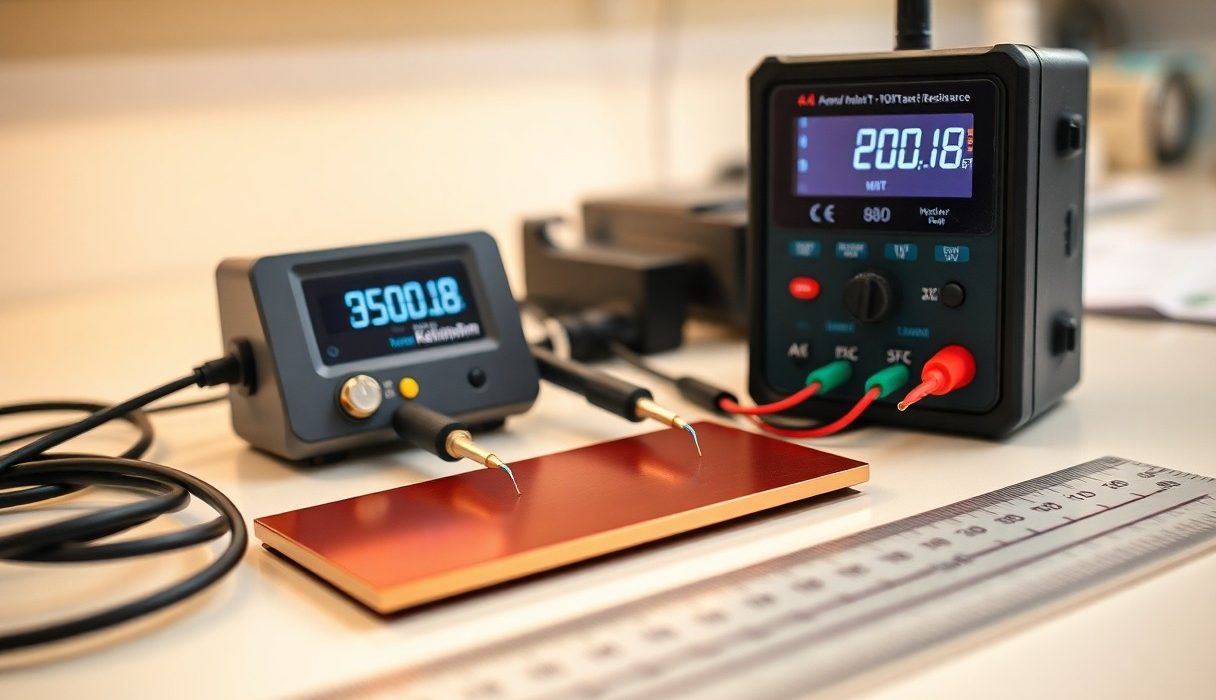
Measurement of contact resistance requires precise technique and safety: you will learn four-terminal (Kelvin) methods to achieve accurate low-resistance readings, how to design tests for consistent, repeatable results, and how to avoid hazards such as overheating, arcing, and equipment damage by controlling current, contact force, and proper fixturing.
Types of Contact Resistance Measurement Methods
When choosing a technique, assess the balance between speed, resolution, and the potential for self-heating: for example, a four-wire setup commonly resolves down to 1-10 µΩ while high-current microohmmeters used on cable terminations may drive 100 A pulses to reveal real-world contact behavior. You should factor in test-fixture geometry, the expected contact resistance range (bolted joints often fall in the 1-100 µΩ range, while plated PCB contacts can be mΩ), and whether you must measure under load or at ambient conditions.
Practical implementations vary: bench work typically uses the Kelvin (four-wire) method for laboratory-grade accuracy, while service checks on installed equipment often rely on two-wire instruments for speed. Always note that high test currents improve signal-to-noise but introduce heating and thermal EMF errors, so your procedure should specify current amplitude, duration, and cooling delays to maintain repeatability.
- Four-Wire Method
- Two-Wire Method
- Bridge Methods
- Pulse / High-Current Methods
- LCR and Source-Measure Units
| Four-Wire (Kelvin) | Best for µΩ resolution; separates source and sense; common in lab calibration; typical currents 0.1-10 A |
| Two-Wire | Simple, fast; includes lead and contact resistance; useful for field checks where relative change matters |
| Bridge (Wheatstone/Null) | High sensitivity at low excitation; good for comparative lab tests and matched-pair component testing |
| Pulse / High-Current | Reveals contact behavior under real load; typical pulse widths 10-500 ms; watch for thermal damage |
| LCR / SMU | Provides frequency-dependent impedance and controlled voltage/current sweeps; useful where contact capacitance/inductance matters |
Four-Wire Method
The four-wire technique uses separate current and sense leads so the voltage drop across the contact is measured without series lead resistance; this delivers repeatable results down to single-digit microohms when you keep sense lead separation and clamp placement consistent. In practice you drive a known current (typically 0.1-10 A for connector tests) through the outer pair and measure voltage with the inner pair; if you need sub-µΩ uncertainty, use short, low-thermal-emf jumper wires and perform measurements in a temperature-stable environment.
To minimize errors, you should torque bolted connections to specified values, use four-terminal adapters for small components, and perform a polarity reversal or averaging to cancel thermoelectric offsets. Note that at higher currents the contact will heat: implement controlled pulse widths (for example, 100 ms) and duty cycles to prevent irreversible change, and log both current and measured temperature when documenting results.
Two-Wire Method
The two-wire approach measures total loop resistance including leads and is fast for on-site checks; typical handheld microohmmeters use this for relative trend spotting where absolute µΩ accuracy is not required. You can expect uncertainties dominated by lead resistance and contact-to-probe interface; for instance, a 10 mΩ lead will swamp a 50 µΩ contact unless you calibrate with a known short or use a four-wire zeroing routine when available.
Field applications often trade accuracy for convenience: you’ll use the two-wire method to monitor degradation over time rather than to establish an exact baseline, and combining periodic two-wire checks with occasional four-wire calibration runs gives a practical maintenance strategy. Emphasize consistent probe placement and cleaning-dirty probes introduce variable offsets that mimic contact deterioration.
Thou always document the lead configuration, applied current, and any zero-offset corrections when using two-wire measurements to ensure your trend data is interpretable.
Step-by-Step Guide to Measuring Contact Resistance
Step Overview
| Step | Action / Key detail |
|---|---|
| Equipment prep | Verify four‑wire (Kelvin) leads, calibrate source/meter, clean contacts with 99% IPA and lint‑free wipes. |
| Setup | Attach current to outer terminals, sense to inner terminals, use short heavy gauge leads (AWG 18 or thicker). |
| Test parameters | Select test current to produce a measurable voltage (typ. 100 mA-5 A for mΩ range), plan current reversal to cancel thermoelectric offsets. |
| Measurement | Stabilize thermal condition, take multiple readings, average or use ±I averaging; log force, temperature, and RH. |
| Analysis | Compute mean ± SD, plot R vs contact force, inspect for wear or oxidation after tests. |
Preparation of Equipment
You should begin by seating and verifying the measuring instruments: use a true four‑wire (Kelvin) micro‑ohmmeter or source‑meter and confirm calibration within the last 12 months. Replace or reterminate leads if you see oxidized clamps; short, heavy gauge leads (AWG 18-12) minimize lead resistance and noise. Clean the contact surfaces with 99% isopropyl alcohol and lint‑free wipes until you see no residue; for plated surfaces a light mechanical abrasion (Scotch‑Brite pad) followed by solvent will often reduce variability between cycles.
Next, set your test currents and ranges based on expected resistance: for contacts in the 1-50 mΩ range choose 0.5-5 A so the measured voltage sits in the millivolt range (e.g., 5 A across 10 mΩ gives 50 mV). Limit current on small or temperature‑sensitive contacts to prevent heating – avoid exceeding 5 A on delicate connectors. Finally, check your sense lead connections and perform a short‑circuit zero measurement to verify offset is <±10 µV (or within instrument spec) before testing samples.
Conducting the Measurement
With the rig assembled, attach current leads to the outer terminals and connect sense leads as close to the contact interface as practical; this reduces series path and measurement error. Apply the chosen test current and wait for the voltage to stabilize-typically 5-30 seconds depending on current and mass of the contact-then record the voltage. Use current reversal (measure at +I and −I) and average the two results to cancel thermoelectric EMFs and DC offsets; for most bench tests a ±I pair with 1-2 second dwell per polarity is sufficient.
Perform at least five repeat measurements and report the mean and standard deviation; in production checklists aim for repeatability better than 5% for mΩ‑level contacts. You should also vary contact force (for example 0.5 N, 2 N, 5 N) and log how resistance changes with force-this produces an R vs force curve that often reveals contamination, plating defects, or contact geometry problems.
To reduce noise and measurement error, keep sense leads short and twisted, use guarding if available, and avoid running test leads near switching supplies; when measuring very low resistances (<100 µΩ) you may need higher currents and a purpose‑built micro‑ohmmeter, while resistances above 1 Ω are better measured with an LCR or two‑wire instrument. Always monitor temperature rise during high‑current tests and stop if the contact exceeds safe limits.
Tips for Accurate Contact Resistance Measurement
Prioritize consistent probe placement and surface preparation: make sure you clean contacts with 99% isopropyl alcohol, remove oxides with a gentle abrasive or appropriate chemical treatment, and avoid overheating plated surfaces. For low-resistance work set a test current that yields a measurable voltage without significant self-heating (typical range 10 mA-1 A; for ~10 mΩ targets 50-200 mA is common), maintain repeatable clamping force using torque drivers or spring probes within ±5%, and always use the four-wire (Kelvin) method with current reversal to cancel offsets from thermal EMF.
- Validate your setup with traceable reference standards (1 mΩ, 10 mΩ) before measurement campaigns.
- Minimize lead length and use low-thermal-EMF connectors; worn probes can shift readings by several µΩ and should be replaced.
- Average multiple reversals (at least four) and allow 10-30 s settling after current steps for thermal equilibrium.
- Log ambient temperature and clamp pressure with each reading; a 1 °C gradient can introduce tens of µΩ on dissimilar-metal joints.
Knowing how tightly you control mechanical contact quality, electrical setup, and environmental variables typically reduces uncertainty into the low µΩ range on benchtop systems and can push below 1 µΩ when combined with temperature control and calibrated standards.
Environmental Considerations
You should eliminate temperature gradients across the specimen because thermal EMF will produce offsets that overwhelm µΩ-level measurements; hold the DUT in an enclosure stable to ±0.1-1.0 °C depending on precision needs. When testing dissimilar metals expect thermoelectric voltages of tens of µV per °C-use current reversal, wait 30-120 s after stepping currents, and, where possible, perform tests in a temperature-controlled chamber to suppress drift.
You also need to control humidity and contamination: store samples in dry cabinets (<10% RH) if oxidation is a concern and consider a dry-nitrogen purge for long-duration or publication-grade tests. Vibration and cable motion cause micro-slip events that create step changes of several µΩ, so mount fixtures on vibration-isolated tables and use strain reliefs for test leads.
Equipment Calibration
Calibrate your current source and voltmeter against traceable reference standards at relevant points (1 mΩ, 10 mΩ, 100 mΩ) and keep uncertainty budgets documented; many labs use standards with 0.01% tolerance and known temperature coefficients to keep systematic error to the ppm level. Verify zero offset by shorting the current leads and performing a four-wire short test-high-end instruments should read within manufacturer short-circuit specs (often <1 µΩ).
You should schedule verification based on use: monthly checks for high-use benches, quarterly for moderate use, and always before critical measurement campaigns. Track drift trends in calibration logs so you spot aging in current shunts, DMM inputs, or source stability-an unexpected 0.1% shunt drift at 1 A equals a 1 mA error that maps directly to a voltage error across low resistances.
More practical calibration steps include using a shorting plug to measure instrument zero, performing a four‑wire short across the fixture (expect readings near your instrument’s short spec), and replacing leads or connectors if the short exceeds a few µΩ; also keep calibration certificates with ambient conditions to preserve traceability and support repeatability.
Factors Influencing Contact Resistance
Multiple variables determine the effective contact resistance, ranging from bulk conductor properties to microscopic films and mechanical loading. You will commonly see combined effects: electrical resistivity and geometry set the baseline, while contact force, wear, and contamination set the operational value; for practical systems this spans roughly 10 μΩ to 100 mΩ depending on connector type, current level, and contact area. Examples: a plated relay contact measured in the lab may be ~100 μΩ, whereas a corroded automotive terminal under load can exceed 10 mΩ and cause heating or intermittent failures.
- Material properties – conductivity, hardness, plating type and thickness
- Surface condition – roughness, oxide/contaminant films, debris
- Contact force – normal load, pressure distribution, spring design
- Environment – temperature, humidity, corrosive gases
- Mechanical wear – fretting, abrasion, welding under high current
Material Properties
You must account for the intrinsic resistivity and mechanical behavior of the contact metals: silver (~6.3×10^7 S/m) and copper (~5.96×10^7 S/m) give lower bulk resistance than gold (≈4.1×10^7 S/m) per unit cross‑section, but gold’s chemical inertness often produces lower long‑term contact resistance in low‑force, low‑current mating because it resists oxide formation. Plating thickness typically ranges from 0.05-3 μm for signal contacts and up to several microns for power contacts; thinner plating can wear through in 10^3-10^5 mating cycles depending on materials and force.
Your choice of hard versus soft contact metal changes how asperities deform: harder alloys maintain geometry under load but can reduce true contact area (raising constriction resistance), while softer metals flow to increase contact spots but are prone to fretting wear. Temperature effects also matter: for copper the temperature coefficient is ≈+0.0039/K, so a 50 K rise will increase bulk resistance by ~20%, impacting high‑current connector designs.
Surface Condition
Surface topography and films often dominate measured resistance: average roughness Ra in practical contacts ranges from 0.05-1 μm, and oxide layers on copper or zinc can be 1-100 nm thick-thin films can still increase resistance by orders of magnitude when they interrupt metallic asperity contact. You should expect oils, flux residues, or dust to raise resistance dramatically; a light hydrocarbon film can turn a milliohm contact into a 10s of milliohm problem until properly cleaned.
In field and lab practice you’ll use targeted cleaning (IPA wipe, ultrasonic bath, plasma clean) or controlled abrasion to restore low resistance; for production, controls like gold flash plating of 0.05-0.5 μm or tin/silver thicker platings are common to mitigate oxide formation. For example, automotive terminals designed for 10-50 A often specify plating >0.5 μm and clip forces delivering several MPa of contact pressure to keep resistance below 5-10 mΩ under vibration and corrosion exposure.
Any change in surface roughness, oxide thickness beyond a few nanometers, or contamination level will shift your measured contact resistance enough to require re‑qualification of the connector or a repeat of the measurement protocol.
Pros and Cons of Different Measurement Methods
You can compare methods across several factors: accuracy at milliohm levels, susceptibility to lead/contact error, test-current induced heating, measurement speed, and suitability for in-service testing. The table below breaks down the common techniques so you can quickly match method to application.
Pros and Cons Summary
| Two‑Wire (simple ohmmeter) | Pros: simple, fast, low-cost; good for resistances >1 Ω. Cons: lead + contact resistance included, large errors at milliohm level (errors easily >50% for mΩ), susceptible to thermoelectric offsets and heating. |
| Four‑Wire (Kelvin) | Pros: separates current and sense, accurate to µΩ-typical bench micro‑ohmmeters reach 0.1-1 µΩ resolution; excellent for connector/joint testing. Cons: requires proper fixture/Kelvin clamps and technique; more expensive. |
| Bridge / Wheatstone | Pros: very stable for lab comparisons, high resolution in controlled setups. Cons: less practical on-field, setup time and balancing required; sensitive to temperature drift. |
| AC Impedance / LCR | Pros: separates resistive and reactive components, useful for coatings and complex contacts. Cons: parasitic inductance/capacitance and skin effect at higher frequencies can distort contact resistance readings. |
| Pulse / High‑current DC | Pros: reveals current‑dependent effects (contact heating, non‑ohmic behavior); simulates real operating stress. Cons: can cause heating or damage if not controlled; requires pulsed current source and fast measurement electronics. |
| Clamp‑on (non‑contact) current sensors | Pros: safe for in‑service checks, no circuit break needed. Cons: lower accuracy for very low resistances and influenced by surrounding conductors; gives indirect measurement (requires model/assumptions). |
| Time‑Domain Reflectometry (TDR) | Pros: locates faults and impedance discontinuities along a conductor. Cons: not a direct contact‑resistance measurement; resolution limited for very short/contact-length anomalies. |
| Micro‑ohmmeter with Kelvin fixture | Pros: engineered specifically for sub‑mΩ repeatable measurements, often includes polarity reversal and averaging. Cons: specialized fixturing and procedure needed; costlier than basic meters. |
Advantages of Four-Wire Method
You get true low‑resistance readings
Practical benefits include repeatability and the ability to use lower test currents to avoid heating; you can accurately compare assemblies span to span and detect small increases in contact resistance that predict degradation. When you pair four‑wire measurement with proper Kelvin clamps and stable test currents, you remove most systematic errors that would otherwise mask small but important changes in resistance. You measure the sum of the contact plus test‑lead resistance, so low‑ohm readings are dominated by fixture and cable contributions. For example, if the true contact resistance is 5 mΩ but your leads add 20 mΩ, the displayed value will be ~25 mΩ – an 80% error that makes the reading meaningless for quality control of milliohm contacts. Additionally, two‑wire tests are sensitive to heating and thermoelectric voltages: applying higher current to improve signal can raise the contact temperature and change resistance during the measurement, and dissimilar metals in the circuit produce offset voltages on the order of tens of microvolts that distort low‑level readings. You’ll find two‑wire adequate for resistances above ~1 Ω, but unreliable for precision milliohm work. To mitigate some issues you can use short, heavy gauge leads, perform polarity reversal (delta mode) to cancel DC offsets, or step up test current while monitoring for temperature rise; nevertheless, these are workarounds and do not replace the inherent advantage of four‑wire configurations when you need accurate, repeatable low‑resistance measurements. When you standardize probe pressure, alignment, and dwell time, variability drops dramatically; aim to keep probe force within a tight band such as 2.0 N ±10% and dwell time consistent (for example, 1.0 s between contact and measurement) so contact resistance repeats to within target limits. Use the same test current every time-typical ranges are 100 mA to 10 A depending on the application-and lock the current source to avoid ramping or fluctuations greater than ±1%, since thermal EMFs and heating scale with current and will otherwise skew results. If you operate a production line, implement written SOPs and fixture jigs that force probe geometry to be identical from part to part; a high-volume assembly line that enforced probe placement and a 1 s settle time cut measurement spread from ~12% to under 2% within three weeks. Also calibrate your measurement method against a known four-wire standard resistor (for example a 1 mΩ or 10 mΩ standard) and perform a quick verification sequence each shift to confirm technique has not drifted. Maintain probe tips, cables, and connector torque to keep baseline resistance stable: clean contact surfaces with 99% isopropyl alcohol and lint-free wipes, replace worn tips when diameter reduction or plating wear exceeds 10%, and follow manufacturer torque specs (common ranges are 0.5-5 N·m depending on connector type). High-current tests can create heat and arcing; therefore inspect insulation and grounding regularly and tag any lead or probe that shows discoloration or pitting-these defects can produce large, sudden resistance jumps that invalidate a batch. Schedule calibration of the instrument and current source every 6-12 months with an accredited lab, and run a daily verification against a reference resistor before production starts; keep logs of drift, and if you see changes greater than 0.5% remove the unit from service until corrective action is completed. In addition, maintain a warm-up period (typically 30 minutes) for precision sources and meters to stabilize internal temperatures before critical measurements. For practical upkeep, develop a maintenance checklist that includes cleaning frequency (for example, end-of-shift wipe-downs and weekly deep-clean), tip lifecycle tracking (count cycles or parts tested), and a simple verification routine: after warm-up take 5 consecutive measurements of your reference resistor, calculate mean and coefficient of variation, and log results in your CMMS; if variability exceeds 0.2% or mean shifts > 0.5%, quarantine the tool and troubleshoot connectors, cables, and probe alignment before resuming use. Following this you can align measurement method to the contact type and the resolution you need: use Kelvin (4‑wire) or dedicated current‑sensing setups for milliohm‑level contacts, TLM or van der Pauw for spatial and sheet resistance characterization, and pulsed techniques when joule heating or transient behavior affects readings. You should prioritize proper fixture design, solid cable management and shielding, stable temperature control, suitable current and compliance limits, and verification of linearity to minimize systematic error. Consistent surface preparation, controlled mating force, and statistical sampling are crucial so your results are reproducible and meaningful. To ensure your measurements reliably guide design and quality decisions, document procedures, use reference standards and routine calibration, log environmental conditions, and apply simple statistical analysis to track drift and variation. Training operators on the chosen protocols and maintaining traceable records lets you detect anomalies early and compare data across devices, batches, and labs with confidence.Disadvantages of Two-Wire Method
Best Practices for Reliable Results
Consistency in Measurement Technique
Regular Maintenance of Equipment
Final Words