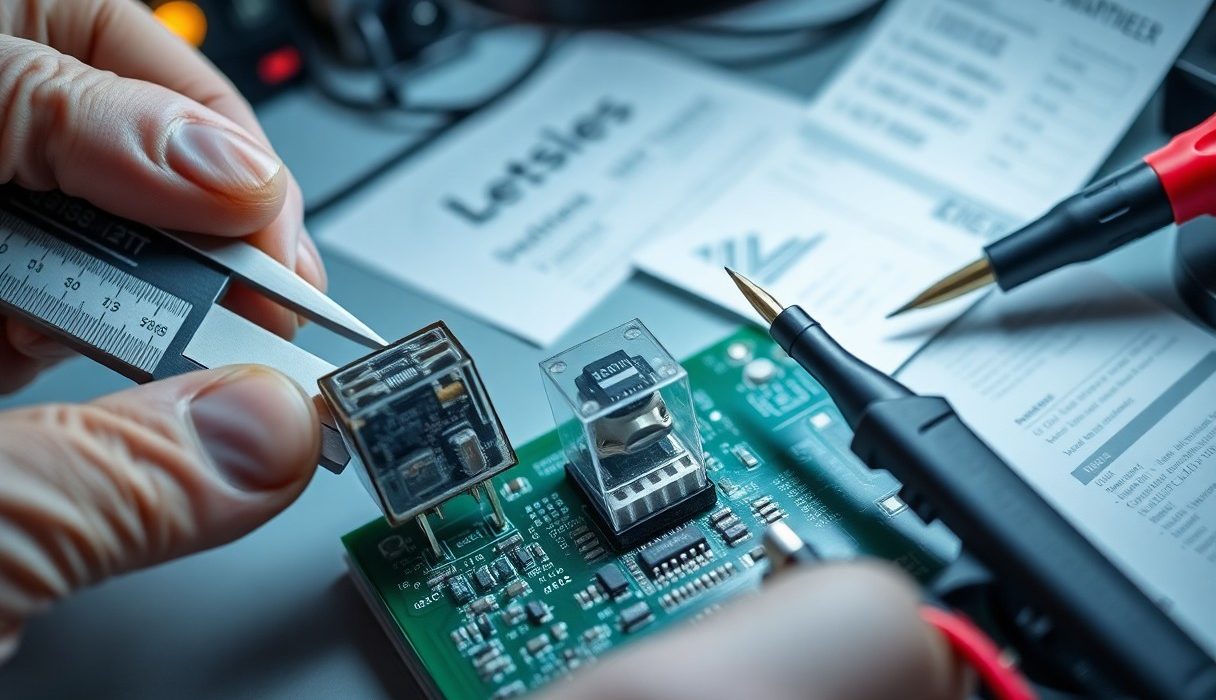
You must evaluate switching speed, contact material, coil power and isolation to match your signal integrity and timing requirements; prioritize minimal contact resistance and long mechanical life for reliability, and guard against overheating, contact welding, and EMI which can destroy sensitive circuits. Assess form factor, rated load, and failure modes so your design achieves stable, repeatable switching with low noise under expected environmental and duty-cycle conditions.
Types of Relays
| Electromechanical Relay (EMR) | Mechanical contacts, galvanic isolation, typical ratings 1-30 A, operate times ~5-20 ms |
| Reed Relay | Small form factor, fast (~0.5-2 ms), low contact current (mA-A range), ideal for signal switching |
| Latching Relay | Consumes no hold power, retains state after power loss, used in low-power and memory applications |
| Solid State Relay (SSR) | No moving parts, switching from µs to ms, has leakage current and on-state dissipation to manage |
| Hybrid Relay | Combines mechanical contact with semiconductor assist to reduce arcing and extend life; higher cost |
- contact bounce
- switching speed
- isolation
- leakage current
- life cycle
Electromechanical Relays
You can expect EMRs to give you straightforward galvanic isolation and very low on-resistance when closed, which is why many precision test fixtures still use SPDT EMRs rated at 10-30 A, 250 VAC. Manufacturers like OMRON and TE Connectivity publish operate times in the 5-20 ms window and mechanical life in the 10^5-10^7 cycle range; that tradeoff directly affects how you plan for maintenance and redundancy.
When you design with EMRs, account for contact bounce (tens to hundreds of microseconds) and arcing on inductive loads; simple RC snubbers or RC+MOV networks often extend contact life. If your application sees high inrush currents (for example, capacitive loads or motor starts), choose contacts plated with silver alloy and spec a margin-for instance a 10 A rated relay is often derated to 6-7 A for continuous inductive switching.
Solid State Relays
You’ll find SSRs excel when you need high-speed switching and virtually unlimited mechanical life-device lifetimes are commonly >10^9 cycles and turn-on times can be 100 µs for MOSFET-based units. Typical SSR drawbacks are leakage current (1-20 mA depending on type), on-state voltage drop (0.5-2 V for TRIAC/thyristor SSRs; lower for MOSFET SSRs), and thermal dissipation that requires careful heat-sink sizing-expect to allocate 1-5 W of dissipation per ampere for some AC SSRs.
You should match SSR topology to the load: choose zero-cross SSRs for resistive AC loads to reduce EMI and inrush stress, and random-turn-on (or MOSFET-based) SSRs for controlled phase firing or precise turn-on timing. For precision measurements, watch leakage-induced offset errors; adding a mechanical bypass or discharge path can mitigate millivolt-level offsets in sensitive circuitry.
If you evaluate concrete specs, note that an SSR such as a typical industrial MOSFET output device may advertise RDS(on) equivalent giving milliohms of conduction resistance but still shows a small OFF-state leakage and requires derating at elevated case temperatures-design your PCB thermal paths and include temperature derating curves from the datasheet.
Hybrid Relays
Hybrid relays pair a small semiconductor stage with a mechanical contact so you get the benefits of both: low on-resistance and negligible leakage during steady conduction, plus reduced arcing during switching. Typical numbers you’ll see are operation times of ~1-3 ms with mechanical contact life extended to >10^7 cycles thanks to the semiconductor handling the make/break transients.
You will pay a premium for hybrids, but the performance payoff can be substantial in precision systems where contact resistance stability and low generated EMI matter-examples include high-precision source-measure units and audio switching banks where thermal EMF and contact oxidation would otherwise degrade measurements. Implementation requires attention to failure modes: hybrids can fail short (if the semiconductor stage fails) or open (if the contact welds), so plan redundancy accordingly.
In practice, hybrids are excellent when you need both the low leakage of a mechanical contact and the soft switching of semiconductors; they often simplify system-level EMI and lifetime tradeoffs but demand careful selection of models with published failure-mode data and lifecycle testing results.
Recognizing how each relay type trades off switching speed, life cycle and isolation will let you choose the optimal device for your precision electronics needs.
Factors to Consider
Assess the electrical and mechanical demands of your design early: match the relay’s Voltage and Current ratings to the worst-case signal or load (for example, signal relays often handle ≤1 A at 30 VDC, while power relays are commonly rated for 10-30 A at 120-250 VAC), specify the needed Switching Speed (reed relays can operate in sub-millisecond ranges, whereas miniature EM relays often take 5-20 ms), and weigh form-factor constraints such as board real estate and clearance. Pay close attention to contact material-gold for low-level signals to avoid oxidation and silver alloys for higher-current switching-and to coil power or drive requirements if you plan battery-powered or dense relay arrays.
- Voltage & Current Ratings – steady and inrush/current surge margins
- Switching Speed – operate/release times, bounce, and frequency
- Size & Form Factor – SMD vs through-hole, height, and footprint
- Contact Material – gold, silver, or plated alloys for signal integrity
- Isolation & Creepage – PCB spacing for mains or mixed-signal designs
- Life & Reliability – mechanical cycles (10^5-10^7) vs semiconductor longevity
Balance performance trade-offs: if you need galvanic isolation and long-term low leakage, a mechanical relay or a gold-contact reed often wins, but expect lower maximum switching frequency and finite mechanical life (typical rated life ranges from 10^5 cycles for heavy loads to >10^7 for light-signal use). When fast, repeatable switching and high cycle counts are required, solid-state options minimize contact bounce and mechanical wear but introduce off-state leakage and on-resistance that can distort microvolt-level measurements. Perceiving how these constraints interact lets you prioritize which characteristic-speed, isolation, life, or signal fidelity-must be dominant for your circuit design.
Voltage and Current Ratings
When you size a relay for precision electronics, treat the rated values as ceilings rather than comfortable margins: for DC switching expect more severe arcing than for AC, so derate DC switching current by roughly 30-50% compared with AC ratings when possible. For ultra-low-level signals (microvolt or microamp ranges) choose relays with low contact resistance – typically ≤100 mΩ for quality signal relays – and gold or noble metal plating to prevent contact oxidation and intermittent opens that will corrupt measurements.
Also account for inrush and inductive loads: a relay rated for 2 A resistive may weld or sustain pitting if you repeatedly switch a 10 A motor inrush or an inductive spike without proper snubbing. If your design must handle both signal routing and occasional higher currents, you can partition duties – use dedicated power relays for the heavy loads and gold-contact signal relays or multiplexers for the low-level paths – to avoid compromised accuracy or contact welding.
Switching Speed
Switching behavior differs widely across types: reed relays typically operate in the sub-millisecond to 1 ms range and have minimal bounce, while small electromechanical relays often operate in the 5-20 ms window with bounce lasting 1-5 ms. Solid-state relays and semiconductor switches can switch in microseconds to milliseconds depending on topology, but you must factor in finite rise/fall times and charge injection that can upset precision ADC samples.
If you’re multiplexing sensitive inputs-for example, scanning 16 channels into a 24-bit ADC at 1 kS/s-you’ll want switching that settles well before conversion; with mechanical relays that may require blanking or debouncing intervals of several milliseconds, whereas a suitable SSR or analog switch can reduce dead time to microseconds but introduces leakage (often 1-50 µA) and on-resistance that affects low-level signals.
More detail: mitigate mechanical bounce by adding simple timing (e.g., a 5-10 ms delay before sampling) or by choosing a reed or hybrid relay; for highest-frequency switching or timed gating you may need MOSFET-based SSRs or low-charge CMOS analog switches, and you should quantify off-state leakage and residual capacitance in your error budget.
Size and Form Factor
Form factor governs layout and mechanical reliability: SMD relays enable high-density assembly and automated pick-and-place but often have lower current ratings and less robust isolation than larger through-hole counterparts. Typical miniature signal relays occupy footprints around 6×6-10×10 mm with heights of 4-15 mm; power relays will be much larger. For mains or mixed-signal boards maintain adequate PCB creepage and clearance-commonly at least 3 mm for 250 VAC circuits-and select a relay package that preserves those distances on the board.
Mechanical mounting affects vibration tolerance and thermal performance: glass-encapsulated reed relays offer compactness and speed but are more fragile under shock, whereas sealed plank or cube relays handle mechanical stress better. If you need many channels in a confined area, consider latching relays to cut coil power and lower thermal load, or choose low-profile solid-state modules to save vertical space.
More detail: review the relay datasheet footprint and recommended land pattern-routing beneath tall relays is often impractical and nearby components can create thermal hotspots that derate coil life; when swapping a relay type for density gains, validate isolation distances, soldering profiles, and mechanical endurance in a small prototype run before full production.
Step-by-Step Selection Process
You should proceed in a structured sequence: define your electrical and mechanical constraints, shortlist relay families that meet those constraints, then perform a side-by-side spec comparison before prototyping. Prioritize low contact resistance for signal integrity, low coil power for thermal budgets, and high dielectric strength when isolation is required.
When you quantify targets, use examples: specify contact resistance <100 mΩ for precision analog paths, derate current by 20-30% for long life, and set life-cycle targets (electromechanical: ~1e5-1e7 operations; reed: up to 1e9). Validate with bench tests that simulate your worst-case voltage, temperature (for example -40°C to +85°C), and switching frequency.
Selection Steps
| Step | Action |
| 1. Define | List voltage, current, switching type, and environmental limits |
| 2. Research | Map relay types to your requirements (reed, EMR, SSR, latching) |
| 3. Compare | Evaluate contact resistance, life, switching time, insulation |
| 4. Prototype | Test in-circuit with target loads and temperatures |
| 5. Verify | Run long-term cycling and EMI/ESD stress tests |
Define Your Requirements
You need to capture electrical, mechanical, and environmental constraints in measurable terms: maximum switching voltage and current, continuous carry current, expected switching frequency, and allowable contact resistance. Include signal-level requirements such as microamp sensing or sub-milliohm path needs so you can immediately exclude inappropriate relay types.
Also specify failure modes and safety margins: determine acceptable contact bounce, required life cycles (for example >1e6 operations for repeated cycling), and derating targets for temperature. Pay attention to inrush currents (motors or capacitive loads) since they often dictate contact material and contact rating for safe operation.
Requirements Checklist
| Parameter | Target / Example |
| Switching voltage | Up to 60 V DC for logic-level, 250 VAC for mains |
| Switching current | 0.1 A for sensors, 2-10 A for loads |
| Contact resistance | <100 mΩ for precision analog |
| Environmental range | -40°C to +85°C typical |
| Life cycles | 1e5-1e9 depending on type |
Research Suitable Relay Types
You should narrow choices to families with demonstrated performance in your use case: reed for low-level signal switching and microamp circuits, electromechanical relays (EMR) for moderate currents with good isolation, and solid-state relays (SSR) where mechanical wear or audible switching is unacceptable. Note that SSRs introduce off-state leakage and on-resistance which can be problematic in precision circuits.
Expect switching time ranges and life-cycle differences to drive your selection: typical EMR operate in 5-10 ms with 1e5-1e7 mechanical cycles, reeds switch in <0.5 ms and can exceed 1e9 operations, while SSRs switch in microseconds but have thermal and leakage trade-offs. Ensure the chosen type supports required isolation voltage-many telecom relays are rated 1500 Vrms.
For matching relays to functions, pick reed for low capacitance and minimal contact wetting current, choose EMR with silver-alloy contacts for higher currents or inductive loads, and use SSR when silence and long life outweigh leakage concerns.
- Reed: best for low-level, high-cycle signal switching.
- EMR: versatile choice for moderate power and good isolation.
- SSR: silent switching and long mechanical life, but watch leakage.
- Latching: minimizes coil energy for battery-powered systems.
- The Isolation: check rated dielectric strength vs. your test and surge requirements.
Relay Type Guide
| Type | When to Use |
| Reed | Low-level signals, fast switching, high cycle life |
| EMR (general) | Moderate currents, good isolation, cost-effective |
| EMR (silver-alloy) | Inductive loads, high inrush resistance |
| SSR | High switching speed, silent, limited by leakage |
| Latching | Low-power hold requirement, battery-operated devices |
Compare Specifications
You must line up datasheet numbers for direct comparison: contact resistance, maximum switching and carry current, operate/release times, coil voltage and current, insulation/dielectric ratings, and specified life cycles. Use quantitative thresholds-for example, demand insulation >1000 Vrms for isolation-critical designs and contact resistance <100 mΩ for precision paths.
Then run case-based comparisons: simulate an inrush of 10× steady current to check contact welding risk, verify coil heating at rated voltage to avoid thermal drift, and confirm that the relay meets IEC 61810 or comparable standards for your application. Highlight any leakage current or contact bounce values that might degrade analog measurements.
Specification Comparison
| Spec | What to Check |
| Contact resistance | Measured <100 mΩ for precision; lower is better |
| Max switching voltage/current | Margin above peak expected values (20-30%) |
| Operate/release time | Match required timing; reeds <0.5 ms, EMR 5-10 ms |
| Dielectric strength | >1000 Vrms for isolation-critical circuits |
| Life cycles | Compare electrical vs mechanical life ratings to duty profile |
When you need a final tie-breaker, prioritize real-world bench testing over paper specs: perform contact resistance under load, thermal ramp tests, and long-duration cycle tests that reflect your switching frequency and ambient conditions.
Verification Tests
| Test | Purpose |
| Contact resistance test | Verify low-resistance path under real load |
| Cycle life test | Confirm expected operational lifetime |
| Thermal stress | Detect coil heating and contact drift |
| EMI/ESD | Ensure immunity and compliance |
| Inrush simulation | Check for welding and contact degradation |
Tips for Choosing the Right Relay
When refining your relay choice, prioritize matching the device to the worst-case electrical scenario: select a relay with a contact rating at least 1.5-2× the expected steady DC current (DC arcs are harder to quench), confirm switching speed (operate/release times typically ~5-20 ms for EMRs), and verify coil power and drive headroom so the coil sees its rated voltage under the highest ambient temperature you expect. For low-level signal switching (µA-mA, <30 V) choose gold-plated contacts; for resistive power switching above 1 A favor AgSnO2 or similar alloys to resist welding and reduce contact arcing.
- Match contact rating to worst-case DC/AC load and include a safety margin.
- Pick contact material by signal level: gold for µA-mA, AgSnO2 for >1 A.
- Design coil drive with sufficient voltage margin and include suppression (diode or RC) for inductive spikes.
- Choose sealed or hermetic packages when moisture, dust, or corrosives exist; target IP67 for immersion-level protection.
- Request manufacturer life and switching-frequency data and plan a small running test at your exact load.
Also make the PCB and mechanical layout decisions early: minimize lead length to reduce inductance when switching fast edges, provide a thermally conductive path or heat-sinking for relays dissipating >0.5 W in the coil, and ensure the relay’s clearance/creepage meets your required isolation (many relays specify ≥1,000 Vrms between coil and contacts).
Consult Manufacturer Guidelines
Always read the datasheet and application notes: check the specified electrical life under rated resistive loads (commonly in the range 10^4-10^7 operations depending on relay type), the mechanical life (often higher), the dielectric strength (typically stated as ≥1,000 Vrms between coil and contact on many parts), and the operate/dropout voltage window for the coil so your driver provides reliable actuation across temperature. Manufacturers also publish contact resistance, maximum switching frequency, and recommended soldering profiles-use those numbers to set pass/fail criteria in your qualification tests.
Request application-specific test data when possible: ask for switching-life curves under DC loads, contact transfer resistance after a defined number of cycles, and any available failure-mode analyses. For example, a telecom module moved from an ungeplated relay to a gold-plated contact rated for low-level signals and saw contact resistance stability improve from ~200 mΩ drift to <50 mΩ over 10,000 cycles; use such case studies to justify selecting a more expensive part for signal integrity. You should also follow the manufacturer's derating charts for temperature and altitude to avoid premature failures.
Consider Environmental Conditions
Account for operating temperature, humidity, contaminants, and altitude: many commercial relays are rated roughly from -40 °C to +85 °C, while industrial or hermetic designs extend to +125 °C. Choose sealed or hermetic relays when condensation, salt spray, or corrosive gases are present; target an IP rating appropriate to the exposure (IP40 for clean indoor, IP67 for splashes/immersion). Also verify the relay’s allowable storage and operating humidity and whether conformal coating on the PCB is compatible with the relay’s materials.
Factor in mechanical stress: specify relays tested to vibration and shock standards relevant to your product (for example, check for MIL-STD-202 or IEC 60068 test reports). Typical commercial relays may be tested to vibration levels of a few g and shock levels of tens to 100 g; if your application sees continuous vibration or >5 g sinusoidal inputs, select parts with explicit vibration qualifications and verify contact stability under those conditions.
Thou should also plan environmental qualification tailored to your design: run accelerated temperature-humidity-bias tests, check for contact resistance drift after salt-fog exposure if deployed outdoors, and confirm switching life at the highest temperature and humidity expected so you can quantify derating and maintenance intervals.
Pros and Cons of Different Relay Types
| Pros | Cons |
|---|---|
| Electromechanical Relays: low on-resistance for high current switching (often <50 mΩ), able to handle inductive loads and high inrush currents up to 30 A in power designs. | Mechanical wear limits life (typically 1×10^5-1×10^7 cycles), contact bounce (1-5 ms) and risk of arcing/contact welding on inductive switching. |
| Solid State Relays: extremely long operational life (>1×10^7-1×10^9 cycles), fast switching (µs-ms), no contact bounce and silent operation suitable for high-cycle applications. | On-state voltage drop and heat dissipation require thermal management; AC SSRs exhibit off-state leakage (mA) and can struggle with low-current loads or large inrush currents. |
| Reed Relays: very low capacitance and fast switching (sub-ms), compact and good for low-level signals and RF switching with minimal contact contamination. | Limited current capacity (typically <1-2 A), magnetically sensitive, and life on mechanical contacts still finite (10^7-10^9 depending on load). |
| Latching Relays: maintain state without continuous coil power (saves energy), useful for battery-powered or safety-hold circuits; available in both mechanical and hybrid forms. | More complex drive requirements (pulse to change state), slower response than some SSRs, and mechanical types still subject to wear and contact degradation. |
Electromechanical Relay Advantages and Disadvantages
You’ll find electromechanical relays (EMRs) very effective when your design must switch high currents or handle significant inrush – many small power EMRs reliably switch 10-30 A and tolerate inductive loads without the thermal stress seen in SSRs. Their very low on-resistance and true galvanic contact make them the go-to choice when you need minimal voltage drop and robust isolation, for example in motor controllers or mains switching modules where contact continuity under fault matters.
At the same time, you should plan for mechanical limitations: typical lifetimes range from 100,000 to several million operations depending on load, contact materials, and switching conditions. Contact bounce, switching times of 5-20 ms, and the potential for arcing and welding under heavy inductive switching mean you’ll often need suppression snubbers, RC networks, or MOVs to protect both the relay and adjacent circuitry in industrial or automotive contexts.
Solid State Relay Advantages and Disadvantages
You can exploit SSRs when you need very high cycle counts and fast, quiet switching – SSRs commonly exceed 10 million cycles and can switch in microseconds for DC MOSFET-based devices or sub-millisecond for TRIAC-based AC types. Their lack of moving parts eliminates bounce and contact wear, which makes them ideal for precise PWM temperature control or high-frequency switching in instrumentation.
On the downside, SSRs present practical limits: AC SSRs typically show off-state leakage in the microamp-to-milliamp range and an on-state voltage drop that creates dissipation (for TRIAC/thyristor SSRs this can be ~1-2 V; MOSFET SSRs can be much lower but require heatsinking). You must also account for diminished performance with high inrush loads – for instance, a heater element with cold inrush can exceed an SSR’s surge rating even if steady-state current is within spec.
Thermal management and derating are key operational details: you should size SSRs with adequate heatsinking and follow manufacturer derating curves (typical junction-to-ambient derating of 0.5-1.5 W/°C for small modules), and select device topology to match the load-use MOSFET-based SSRs for low-voltage DC switching and choose random/phase-control types carefully for AC dimming or phase-angle applications to avoid unintended conduction during partial cycles.
Common Applications of Precision Relays
Test & Measurement and Data Acquisition
You’ll often select reed or micromechanical relays for switch matrices and low‑level instrumentation because they deliver very low contact capacitance (often <1 pF), contact resistance under 200 mΩ, and switching times in the 0.5-2 ms range, which preserves signal integrity for microvolt and picoamp measurements. In practice, replacing general-purpose relays with dedicated low‑capacitance devices has reduced injected transients from roughly 100 mV to under 10 mV in laboratory switch systems, and contact lifetimes commonly exceed 10 million cycles for non‑abusive use-facts you should weigh when balancing throughput versus longevity.
Medical, Aerospace, and Power Management
When you’re designing for patient‑connected equipment or avionics, insulation, creepage/clearance and environmental ratings dominate relay choice: IEC 60601‑1 reinforced insulation and MIL‑STD temperature ranges (typically −55 °C to +125 °C) drive selection toward relays rated for high dielectric strength and long term reliability. For power tasks-battery disconnects or line card switching-you’ll encounter continuous currents from single‑amp telemetry up to hundreds of amps in EV systems, so you may prefer latching electromechanical relays or low RDS(on) solid‑state devices; be aware that switching inductive loads can create voltage spikes exceeding 1 kV, so include snubbers or TVS protection in your design.
Conclusion
From above, you should balance contact type, switching speed, contact resistance, coil drive, and materials to align the relay’s electrical and mechanical behavior with your signal integrity and lifecycle goals. Prioritize low contact resistance and minimal bounce, match coil specifications to your drivers, and choose materials and contact configurations that minimize noise, leakage, and wear for the measurement bandwidth you care about.
Ultimately, validate your selection with prototype testing, review datasheet test conditions and reliability data, and engage suppliers for application-specific guidance so your final relay choice supports the precision, repeatability, and longevity your design requires; consider reed, latching, or solid-state options based on trade-offs among isolation, capacitance, switching speed, and durability.